by Gary Reinecke | Feb 25, 2026 | Uncategorized |
Reflections from the So Cal Multiply Conference: More than a Model
For the last couple of weeks, I’ve been sharing an invitation to the So Cal Multiply Conference, and after spending time with Brian Johnson from KC Underground, I’m still processing the depth of what was shared.
Rather than a dry summary of points, I want to share the heart of what I took away. If you want the deep dive into the “how-to,” I highly recommend checking out their Missionary Pathway Toolkit. But for now, here are the five shifts that are currently rattling around in my soul:
1. The Banner Over Everything: Jesus is Lord
It sounds simple, right? But Brian challenged us to consider if everything—our strategies, our budgets, and our very lives—actually falls under the banner of “Jesus is Lord.” If He is truly the center, then the pressure is off of us to “perform” and back on us to simply obey.
My takeaway: The term “deconstruction” carries negative connotations in our Christian church and community conversations today. In a positive light, however, it is helpful to willingly offer our lives and ministries to Jesus so that He can strip away those aspects that are not under his lordship. This has been painful for me – but worth it!
2. The Disciple-Maker’s Rhythm
We often look for a “silver bullet” for church growth, but the pathway shared at the conference felt much more like a natural, living rhythm. It starts and ends with Extraordinary Prayer and Fasting.
From that place of spiritual intensity, we move through a beautiful progression:
- Incarnational Mission: Being present where people actually live.
- Planting the Gospel: Letting the Word take root in new soil.
- The Church Emerges: Watching a spiritual family form naturally.
- Multiplication: Doing it again, and again.
My takeaway: I love the simplicity; however, I don’t have a habit of practicing the first and most important rhythm of Extraordinary Prayer and Fasting, which explains a lot of things…
3. Redefining the “Ordinary.”
One of the most refreshing parts of the weekend was the language used to describe the work. We aren’t looking for “super-pastors”; we are looking for ordinary people.
- The Disciple-Maker: Just an ordinary person who plants themselves in an unreached network to love people and share the Gospel.
- The Microchurch: Not a “mini-service,” but an extended spiritual family (an oikos) of 10-25 people doing life together.
- The Collective: This is the “connective tissue” that shares resources, governing elders, mission, and larger gatherings (sometimes).
- Hub Team: A catalytic team that exists to equip, coach, and convene disciple-makers and MCs within a geographic area or affinity.
My takeaway: An upside-down triangle was the image used to illustrate the Disciple-Maker at the top and the Hub Team at the bottom. The purpose? The Hub Team supports the three layers above with the Disciple-Maker at the top on the front lines, working in the Harvest.
4. Getting the Flow Right
This was a “lightbulb moment” for me – one that I have heard and read about from Alan Hirsch, author of The Forgotten Ways, Reactivating Apostolic Movements, before, but it hit me differently at the conference. If we start with Ecclesiology (how we do church), we often end up stuck in tradition, but if we follow the proper flow, everything changes:
Christology (Who is Jesus?) → Missiology (What is He doing in the world?) → Ecclesiology (How should the church look to support that mission?)
My takeaway: When our view of Jesus is big enough, it dictates our mission, which then dictates what the church looks like.
5. The “Ecclesial Minimums.”
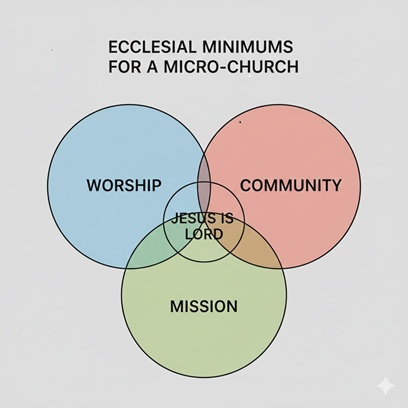
We often overcomplicate what it means to be “The Church.” Brian stripped it back to a simple Venn diagram. At the center is Jesus is Lord, and where these three circles overlap, the church exists:
- Worship: Our devotion to God.
- Community: Our devotion to one another.
- Mission: Our devotion to the world.
My takeaway: this is a helpful tool to assess the health of a micro-church; ideally, each circle is in balance with the other – see image above. When one is larger than the others, the MC coach asks the MC leader, “How can you bring balance?”
A Question for the Road
As I look back on the weekend, one question keeps rising to the surface:
How well are we doing at seeing the church fill everything in every way? If the church isn’t just a building on the corner, but a people scattered into every neighborhood, hobby group, and workplace, the possibilities for multiplication are endless.
Multiplication Evaluation
Are you curious about multiplication? I received permission to synthesize this list from “Becoming a Level 5IVE Multiplying Church Field Guide” by Todd Wilson, Dave Ferguson, with Alan Hirsch. In addition, I created a simple evaluation for your use that is available here.
by Gary Reinecke | Feb 20, 2026 | Uncategorized |
Can we talk about the “Multiplication Gap”?
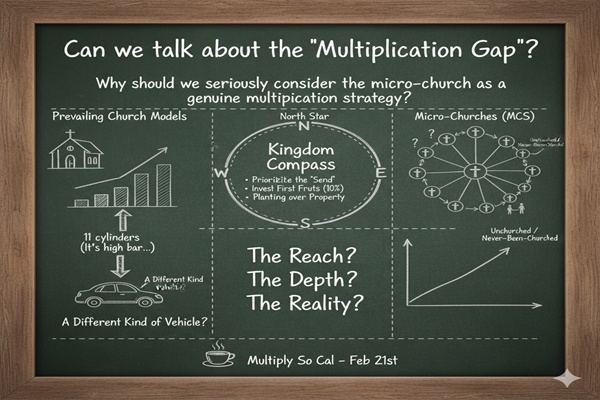
I’ve been sitting with a question lately that I can’t quite shake: Why should we seriously consider the micro-church as a genuine multiplication strategy?
Last week, I shared a list of metrics that, honestly, felt a bit jarring. When I look at the “11 cylinders” of a multiplying church, it’s tough to imagine a movement in the US right now that is firing on all of them. It’s a high bar, and it has me wondering if we need a different kind of vehicle to get there.
The Questions on My Heart
I’ve been leaning into the world of micro-churches (MCs), but I’m still wrestling with what’s “aspirational” versus what’s actually happening on the ground. I’d love to know which of these questions resonates with you:
- The Reach: Are MCs actually connecting with the “unchurched,” or even the “never-been-churched”? Or are we just reshuffling the same deck?
- The Depth: Are we seeing real spiritual DNA being passed down? I’m looking for that third, fourth, or even fifth generation of disciples.
- The Reality: Is the “fruit” in these networks significantly different from what we see in our prevailing church models?
A Different Kind of Compass
To help frame this, I’ve been looking at the Kingdom Compass (synthesized from the Level 5IVE Multiplying Church Field Guide by Todd Wilson, Dave Ferguson, and Alan Hirsch).
If we want to be churches that truly multiply, the “North Star” looks a bit different. It’s less about hitting an internal attendance milestone and more about:
- Prioritizing the “Send”: Celebrating when people leave their seats to start something new.
- Investing First Fruits: Putting 10% of the budget toward planting, before the mortgage.
- Planting over Property: Choosing to birth an autonomous church before buying land or launching a multi-site campus.
Self-Evaluation: I’ve put together a simple evaluation tool based on these metrics. [CLICK HERE to receive a copy] and see where your current rhythm lands.
Let’s Dream Together
If these questions are stirring something in you, I’d love to grab a coffee or, better yet, see you at Multiply So Cal on February 21st. It’s going to be a space to stop “managing” and start dreaming about what God wants to do in our region. Check out the details here!
What about you? When you look at these 11 metrics, which one feels the most challenging—or the most exciting—for your context?

by Gary Reinecke | Feb 11, 2026 | Uncategorized |
Reality – very few churches in the United States multiply. Some reproduce (4%). More people add new people, but are not reproducing or multiplying (16%). Most have plateaued or are in decline (80%). However, internationally, the story is much different. You can read more here: Smaller (much SMALLER) Churches Prevail + Bigger (much BIGGER) Churches are Needed.
Why do I bring this up?
Recently, I was corresponding with a church multiplication network leader, and asked, “What metrics do you track to assess the health of your churches?” He responded – “I would like to have a conversation about this…” That triggered a little research on my part to curate content on church multiplication and make it accessible to my people (you). Prayerfully, I want to help you make sense out of the plethora of information that you are inundated with in podcasts, blogs, and conferences – or in conversation with peers.
I invite you to reflect on a list of practices that multiplying churches demonstrate, but don’t let this list overwhelm you. Multiplication isn’t about being “perfect”; it’s about being reproducible. It starts with a shift in the heart—moving from “How do I grow my church?” to “How do I grow the Kingdom?”
I received permission to synthesize this list from “Becoming a Level 5IVE Multiplying Church Field Guide” by Todd Wilson, Dave Ferguson, with Alan Hirsch. In addition, I created a simple evaluation for your use that is available here.
The Kingdom Compass
Multiplying churches…
- Prioritize Residency: They always have interns or residents in the pipeline, specifically preparing them to be sent out within the year.
- Shift the Focus: They care more about the birth of new churches than they do about hitting their next internal attendance milestone.
- Invest “First Fruits”: They commit at least 10% of their budget to church planting and “tithe” on building funds to ensure the mission outpaces the mortgage.
- Plant Before Property: They prioritize planting an autonomous church before they ever take on land or building debt.
- Plant Before Multi-Site: They choose to send out an independent church before they launch a satellite campus of their own.
- Work a Real Plan: They don’t just have a “vision” for doubling their planting; they have a concrete, actionable strategy to make it happen.
- Send the Best: They release their first church planter before they have a massive staff, and they keep “sending” their leadership capacity away.
- Issue the Public Call: They regularly stand before the congregation and ask people to leave their seats to join a planting team.
- Celebrate the Send: They make church planting the “hero” of their stories, celebrating it publicly to inspire the whole body.
- Challenge Sacrificial Giving: They call their members to give above and beyond their normal tithe, specifically to fund new works.
- Collaborate with Networks: They don’t fly solo; they stay active in a church-planting network or denomination committed to multiplication.
If you missed it above, CLICK HERE for the self-evaluation for each practice of a multiplying church.
You are doing the hard work of a pioneer. Whether you are at a place where you can implement one of these or all eleven, your faithfulness is seen. Keep dreaming, keep sending, and keep leaning into the One who promised that He would build His church.
Dive deeper into the multiplication conversation!
If you’re looking to dive deeper into the multiplication conversation, there’s an upcoming gathering on February 21st called “Multiply So Cal” that I think you’ll really enjoy. It’s a perfect opportunity to dream and grow together. Check out the details here!
by Gary Reinecke | Feb 4, 2026 | Uncategorized |
Bridging the Divide: How “Disciple-Making Cohorts” Can Open Doors for the Micro-Church Movement
I was having a conversation with a respected church leader the other day, and we were discussing the future of the church and various ministry models. As the conversation naturally drifted towards smaller, more intimate gatherings, I found myself using terms like “micro-church” and “house church.”
It was subtle at first, but then it became undeniable. I watched as a visible shift occurred in his demeanor. A flicker of skepticism, then a tightening around his eyes. The friendly, open conversation began to stiffen. It was a visceral response, almost as if an invisible wall had materialized between us. While he remained polite, his body language communicated a clear message: “This will not work here!”
It was a stark reminder of the ingrained biases many hold when it comes to the classic, traditional church model. For some, the terms “micro-church” or “house church” conjure images of something less-than, unorganized, or even (Dare I say it?) a bit rebellious. It’s a knee-jerk reaction, born from years of experience and a deep-seated commitment to what they know and believe works.
This experience got me thinking: how can we communicate the incredible value and biblical foundation of these smaller, more relational expressions of faith without immediately triggering that defensive response? How can we speak to those who are resistant or closed to the idea, without them shutting down before we’ve even had a chance to share the vision?
The answer, I believe, lies in our language.
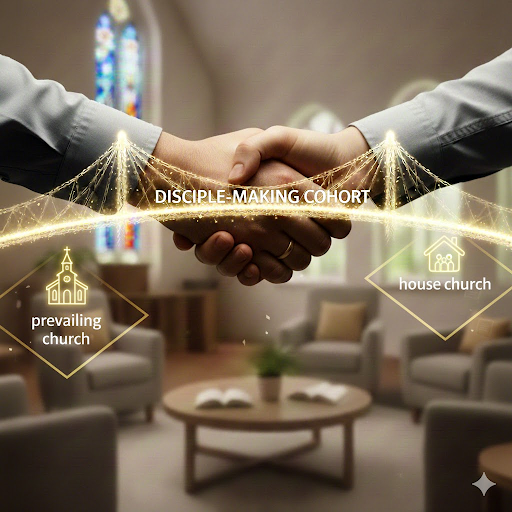
Instead of terms that can evoke preconceived notions, what if we adopted language that emphasizes the core mission and value proposition of these gatherings? What if we shifted from “micro-church,” “house church,” “missional community,” or even “organic church” to something like “Disciple-Making Cohort”? I give my friend Dennis Bachman (Via Cordis, house church network leader) credit for the term.
Think about the implications of that term.
- “Disciple-Making” immediately grounds the conversation in the Great Commission. It highlights the primary purpose of these gatherings: to make and mature followers of Jesus. It speaks to intentional growth, learning, and transformation. Ultimately, the fruit of a disciple is other disciples, making disciples – multiplication!
- “Cohort” implies a dedicated group, a focused journey, and a sense of shared purpose. It sounds intentional, structured (even if organically so), and collaborative. It removes the ambiguity that “house church” might have for some, suggesting a casual gathering rather than a committed community. And avoids the negative connotation of “micro-churches” being ingrown, closed to outsiders, and just plain weird!
A “Disciple-Making cohort” immediately communicates intentionality, spiritual growth, and community. It focuses on the what and the why rather than the how or the where. It emphasizes the core biblical mandate of following Jesus and helping others do the same, which is something every church leader, regardless of their preferred model, can get behind.
This isn’t about abandoning our convictions or hiding what we do. It’s about strategic communication. It’s about finding common ground and building bridges of understanding. When we use language that resonates with the values and priorities of those we’re trying to reach, we open doors that might otherwise remain firmly shut.
Imagine starting a conversation about forming “Disciple-Making cohorts” with that church leader. The immediate visual isn’t a potentially unkempt living room, but rather a group of committed individuals earnestly pursuing spiritual growth together. The visceral response of “this will not work here!” is much less likely. Instead, it invites questions, curiosity, and perhaps even a shared vision for making disciples in a new and effective way.
As leaders involved in micro-church and house church movements, passion is evident. But sometimes, that passion needs to be tempered with strategic communication. Let’s consider how we can effectively share the transformative power of these smaller, nimble expressions of faith with those who currently see them through a lens of resistance.
Reflection Questions for Micro-Church/House Church Leaders:
- What terms do you currently use to describe your ministry, and what perceptions might those terms evoke in someone unfamiliar or resistant to the concept?
- How can you articulate the core mission and values of your “micro-church” in a way that resonates with the biblical mandates that traditional church leaders also uphold?
- Beyond language, what are other potential biases or assumptions people might have about smaller church models? How can you proactively address these?
- When you encounter resistance, how do you typically respond? What new approaches might you consider to maintain an open dialogue?
- If you were to frame your ministry as “Disciple-Making Cohorts,” what practical implications or shifts might that require in your communication, vision casting, or even internal understanding?
If you’re looking to dive deeper into the micro-church conversation, there’s an upcoming gathering on February 21st that I think you’ll really enjoy. It’s a perfect opportunity to dream and grow together. Check out the details here!