I’ve recently been working alongside an incredible team of leaders who coach pastors across their region. To kick things off, I introduced a leadership self-assessment called the Leadership Effectiveness Profile. It offers a quick, comprehensive snapshot of effectiveness across eight vital skill areas:
Emotional intelligence
Contextual thinking
Directional clarity
Creative assimilation
Change orchestration
People enablement
Reciprocal communication
Driving persistence
It’s always revealing! And tucked away at the back of the resource is a practical worksheet for building a Personal Development Plan.
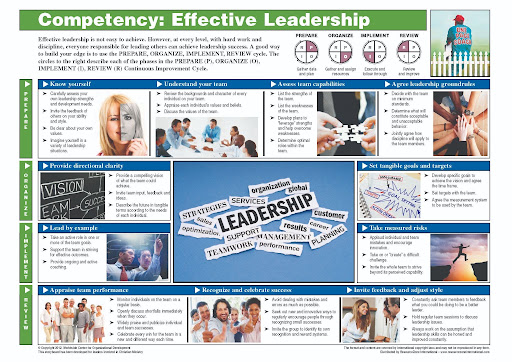
While the profile itself is fantastic, what really brought the experience to life was a live exercise I did with one of the participants. We used it to frame a real-world journey of leading an actual team through a four-phase development process: Prepare, Organize, Implement, and Review (You can picture that rhythm mapped out in the upper right corner).
Suddenly, the conversation shifted. We weren’t talking about nebulous ideas or theoretical leadership models anymore—we stepped straight into the real situations that give our work teeth.
The Effective Leadership Storyboard: Your Visual Line of Sight
Think of a storyboard as your visual line of sight—a clear, guiding map that takes you from where you are today to where you are called to be as a leader. By stepping back and looking at the bigger picture, you can walk purposefully through three transformative Development Outcomes:
1. Navigate the Journey: Identify the foundational stages—Prepare, Organize, Implement, and Review—so you always know your next best step.
2. Sharpen Your Discernment: Recognize the distinct characteristics of both effective and ineffective strategies, helping you choose actions that truly bear fruit.
3. Cultivate Personal Growth: Discover and lean into the specific behaviors designed to equip you for your unique future leadership goals.
5 Steps to Engage a Leader in Growth & Development
If you’re looking to spark meaningful growth with someone you lead or coach, here are five steps to bring it all together:
Identify the Context: Help the leader pin down a real, live situation. Maybe it’s a team they’re actively guiding, a problem they are currently bogged down in, or an individual who isn’t quite pulling in the same direction as the rest.
Assess Where They Are: Ask them to locate themselves on the storyboard framework. They might find themselves in one box, or spanning two or more all at once. From there, prioritize which area is most pressing today.
Reflect on Their Skills: Connect the dots by identifying which leadership skills are most critical given their current phase on the journey.
Brainstorm Ideas: Open up the possibilities. Encourage them to look at the specific skills required for that stage, and brainstorm ways to grow the most under-developed areas that are essential to moving forward.
Plan Personally: Invite the leader to do the heavy lifting. Give them space to write out their intentions clearly—what they plan to do, how they will achieve it, the timeline, and the support they’ll need along the way.
Where does this work?
Here are three areas this resource could be of help to you. Let’s assume you are the lead pastor or a denominational leader.
Personally – provides a framework of how to work with your team through the journey
Empowering others – think of people on your team who would benefit from you coming alongside them to develop their team
Where are you finding the greatest traction in your leadership journey right now? If you would love to explore how to take that next step, let’s set up a brief, 30-minute conversation to let us know how we can help – CLICK HERE.
Bringing a visionary shift to life—whether you are introducing a disciple-making culture where one didn’t exist, coaching into a command-and-control environment, or turning addition into multiplication—is one of the most rewarding and challenging adventures we can undertake. It takes patience, conviction, and a whole lot of heart.
Over the years, walking alongside leaders and communities through these pivots, I’ve picked up a few invaluable lessons on how to move an inspiring idea off the whiteboard and right into the daily rhythm of life.
1. Embed Context Directly Into the Training
When introducing something entirely new, theory alone will only get you so far. People need a mirror before they can see the path forward.
Make it personal: When training leaders in coaching, for instance, don’t just talk about active listening or powerful questioning in the abstract.
Use tools for self-discovery: Ground the training in immediate context by using assessments like the Leadership Effectiveness Profile. When individuals see their own growth edges clearly, the training shifts from an external requirement to an internal desire.
2. Provide Proof That It Actually Works
People rarely move on promises alone; they move on proof. Skepticism is completely natural when a culture is asked to change, and the best antidote is a lived story.
Share real testimonies: Let the results speak for themselves by highlighting how real leaders’ lives and ministries have been impacted.
Celebrate early wins: When people hear a peer say, “This changed how I lead my family,” or “This unlocked a breakthrough in my team,” the abstract vision suddenly becomes a tangible, achievable reality.
3. Build a Team of Committed Change Agents
You cannot carry a new culture alone. Trying to push a vision forward by sheer force of will is an exhausting road that leads straight to burnout.
Find the early adopters: Look for the people who are already naturally modeling the exact behavior and values you want others to experience.
Empower the inner circle: Bring these key influencers into the fold early, listen to their feedback, and let them champion the movement alongside you. Culture is caught much more than it is taught.
4. Use a Control Group as a Learning Lab
Before rolling any major shift out across an entire organization or network, give yourself space to experiment, iterate, and refine.
Run a pilot study: Set up a dedicated control group or cohort to test the new approach in real-time.
Reflect and adapt: Treat this group as a living case study where you can safely test assumptions, look at what’s working, learn from what isn’t, and adjust your strategy before scaling up.
Shifting a culture isn’t about flipping a switch; it’s about cultivating a garden. By anchoring your training in context, proving the fruit, gathering your people, and learning as you go, you pave a clear, sustainable road from where you are to where you are called to be.
What is one area of your leadership right now where you are hoping to see a vision finally take root?
When you sit back and watch how people navigate their disciple-making journeys, one thing becomes crystal clear: there isn’t a one-size-fits-all path. Each person’s story is unique, marked by distinct turning points that propel them forward. While simple, reproducible cycles can help map out the process, we run into trouble when we try to rush it.
So, how long does it actually take for someone to move from their first introduction to the Gospel to baptism?
Honestly, it depends entirely on the context. Sometimes it happens almost instantly; other times, it takes decades.
I recently tried to intentionally build a relationship with a new friend, and I quickly realized how easy it is to make assumptions and get things wrong. After a few failed attempts to get together, we finally went on a hike. It was so much fun just discovering what he cared about—no pressure, no agenda other than getting to know one another. The entire time was spent simply connecting. It was a good reminder that trust building takes time.
I was reminded that the gap between initial awareness of God and becoming a devoted follower of Christ can be bridged by a guide—a person or community who listens intently, offers a safe place to process, and supports the journey.
Three Things a Guide Does to Support a New Disciple
Connect: Build authentic, agenda-free trust with the person right where they are.
Assess: Pay close attention to understand where they currently sit on their spiritual journey.
Identify: Help them discover a practical, personal next step to move forward.
If you are walking alongside someone exploring faith—or want to sharpen your ability to connect—try this simple practice next time you grab coffee or head out on a walk:
1. Ask: “What are you most excited about today?” Then, truly listen.
2. Ask: “What do you love doing in your free time?” Listen again.
3. Reflect on their responses and note what you learned about them that you didn’t know before.
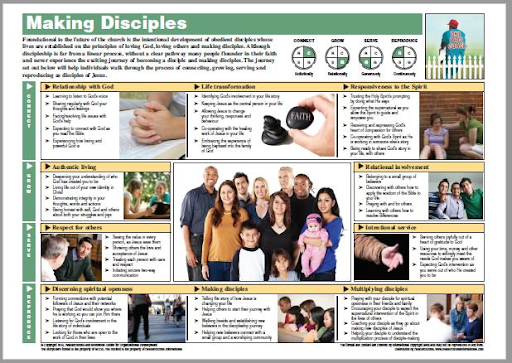
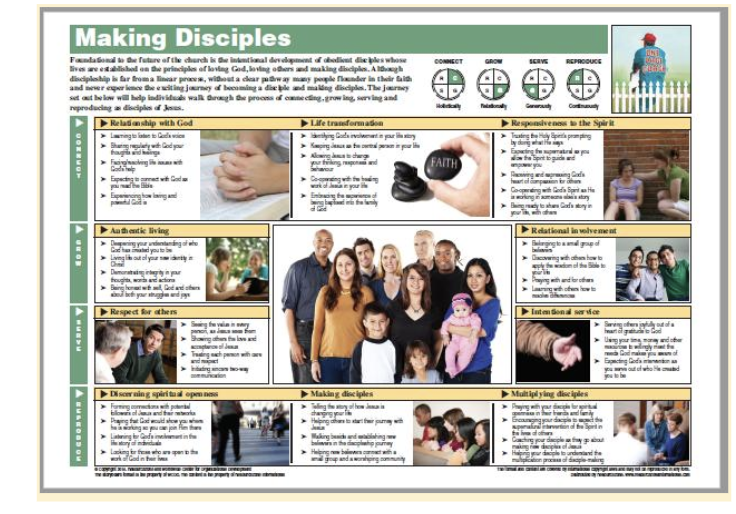
Below is a guide that can help you learn about the disciple-making process, consider questions that can be asked of the disciple to help open up the conversation, and identify where they are on their journey. Click on the image below!
Want to take a closer look at the Making Disciples Storyboard?
Ever had one of those moments where someone asks you a simple question, and your brain decides to answer with everything including the kitchen sink?
That happened to me recently in a workshop. A participant raised their hand and asked a straightforward question: How do you define coaching for disciple-making?
Instead of giving a crisp response, I launched into a convoluted explanation that felt more like a sprawling lecture than a helpful answer. As soon as the words left my mouth, I knew I needed to step back and reflect.
How could I make this succinct, clear, and actually compelling?
To get there, I realized I had to start with the foundational question: What is a disciple?
Back in seminary, I had the privilege of observing Bill Bright up close. His heart and passion sparked a fire in me—a commitment to spend my life understanding discipleship. Forty years later, I’m still on that quest.
If I had to boil four decades of learning down to its simplest form, it’s this:
A disciple is an apprentice of Jesus who loves God, loves neighbors, and makes disciples.
Why Coaching Matters Today
Tools like The Four Spiritual Laws or The JESUS Film were remarkably fruitful in a modern culture that valued clear, logical arguments. But the culture has shifted.
Today, people far from God are far more likely to embrace truth when they discover it for themselves, rather than when it’s handed to them.
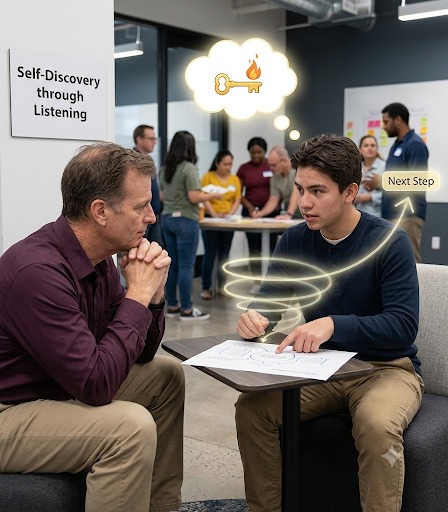
This is why a coach approach is so crucial right now. We all take far more ownership over the truths we uncover ourselves. During that same workshop, I coached a campus pastor to brainstorm fresh steps for his ministry. The three ideas he generated didn’t come from me—he landed on them himself. And the idea he was most excited to act on was the very last one he discovered.
A Working Definition
With that in mind, here is my attempt to integrate a coaching mindset directly into disciple-making:
Disciple-making coaching is listening well to empower apprentices of Jesus to discern their next step to love God, love neighbors, and multiply disciples.
It centers on three things:
Listening: Tuning into the Holy Spirit while deeply listening to the person in front of you.
Empowering: What happens when someone discerns God’s voice for themselves.
Multiplying: Keeping the process simple enough to reproduce over and over.
I’d love your feedback!
Does this definition hit the mark for you, or is there a word you’d tweak, add, or cut? I read every reply and would value your perspective.
Ever stumbled across a single comment in a podcast that made you completely pause and rethink a common workplace practice?
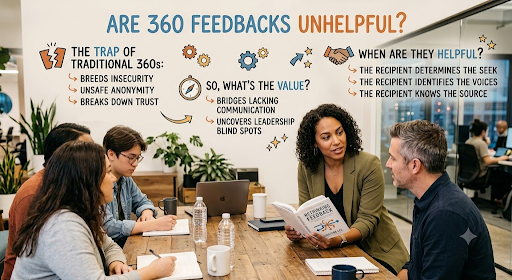
I was recently reading a book by a highly respected author who brought up 360-degree feedback assessments, and he dropped a surprising conclusion: 360 feedback is actually unhelpful to the person receiving it.
At first, that might sound counterintuitive. We’ve been taught that more feedback is always better, right? But as he broke it down, the reasoning really resonated.
Why Traditional 360s Fall Short
When you look under the hood, traditional 360-degree reviews often backfire for three main reasons:
They breed insecurity: Instead of inspiring growth, getting a massive dump of critique often leaves people feeling defensive, overwhelmed, and second-guessing themselves.
Anonymity makes them feel unsafe: When feedback is anonymous, it loses its context. It leaves the recipient trying to guess who said what, turning a growth exercise into a psychological mystery game.
They break down trust: Rather than bringing a team closer together, secret critiques can create paranoia and weaken the authentic bonds between colleagues.
Do 360s Have Any Value?
That’s not to say 360s are completely useless. They do serve a purpose in specific scenarios:
Filling a cultural gap: If a team lacks a healthy, everyday culture of open communication, a formal 360 can serve as a temporary bridge to get people talking.
Uncovering blind spots: For leaders who truly have no idea how their behavior impacts others, the raw data can be a necessary wake-up call.
Flipping the Script: How to Make 360s Work
So, how do we fix this? I had a conversation with a leader of a mission agency recently and discussed how 360 assessments can actually be transformative, but only when we hand the steering wheel back to the team member.
Feedback becomes genuinely helpful when:
1. The recipient drives the focus:They decide what specific areas they want feedback on.
2. The recipient chooses the voices:They select the colleagues whose perspectives they value and trust.
3. Transparency replaces anonymity:They know exactly who gave what feedback, creating a safe space for real, constructive follow-up conversations.
When we shift from evaluating people in secret to empowering them to ask for the insights they need, feedback stops being a source of anxiety and becomes the powerful tool for growth it was always meant to be.
We use cookies to optimize our website and our service.
Functional
Always active
The technical storage or access is strictly necessary for the legitimate purpose of enabling the use of a specific service explicitly requested by the subscriber or user, or for the sole purpose of carrying out the transmission of a communication over an electronic communications network.
Preferences
The technical storage or access is necessary for the legitimate purpose of storing preferences that are not requested by the subscriber or user.
Statistics
The technical storage or access that is used exclusively for statistical purposes.The technical storage or access that is used exclusively for anonymous statistical purposes. Without a subpoena, voluntary compliance on the part of your Internet Service Provider, or additional records from a third party, information stored or retrieved for this purpose alone cannot usually be used to identify you.
Marketing
The technical storage or access is required to create user profiles to send advertising, or to track the user on a website or across several websites for similar marketing purposes.