
by Gary Reinecke | Mar 18, 2026 | Uncategorized |
I recently had the privilege of sitting in on a webinar with Brent O’Bannon, hosted by the Professional Christian Coaching Institute. Brent has this incredible depth of wisdom when it comes to the Gallup StrengthsFinder, but what really stopped me in my tracks was how he applied his insights to the way we build relationships.
He shared three “rules” for how we interact with others, and I couldn’t help but see how perfectly they fit into our mission of making disciples.
The Three Rules of Connection*
- The Golden Rule: Treat others the way you want to be treated. (The classic foundation!)
- The Platinum Rule: Treat others the way they want to be treated. (Meeting them where they are.)
- The Diamond Rule: Embracing the absolute uniqueness of your “disciple” just as much as you embrace your own. It’s not one at the expense of the other; it’s holding and honoring both identities at the same time.
*Used with permission.
Raising the Standard
As I’ve reflected on this Diamond Rule, I’ve been wondering: What if our disciple-making environments were defined by this kind of depth? Imagine how much more powerful our work in the Harvest could become if we raised the bar for how we engage with the world. Wouldn’t it be something if people far from God started describing Christians as “the most respectful listeners I’ve ever met”? That would be a beautiful kind of “jarring.”
Listening in the Chair
The truth is, it’s hard to truly put ourselves in someone else’s shoes if we’ve never carried their specific burden.
For the past year, every four weeks, I visit “Polly” (not her real name) to get my hair cut. Each time I sit in her chair, she shares the heavy reality of her husband’s life—the partial paralysis, the chronic headaches, and the grief following a brain surgery that didn’t go as planned. Barring a miracle, this is their “new normal.”
In that chair, my best tool isn’t catchy Christian phrases or a sermon; it’s asking questions and truly listening. Last month, after hearing the latest update, I simply asked if I could pray for her. She didn’t hesitate.
I prayed quietly, empathetically, and respectfully. Prayer is many things: a way to talk to God, a demonstration of care, and a weapon to push back the darkness. But to pave the way for that prayer, I had to apply the Diamond Rule first—building a bridge of trust by honoring exactly who Polly is at that moment.
Bringing Out the “Diamond” in Your Disciple
The next time you’re in a conversation and find yourself struggling to move from your own perspective to a “Diamond” level of connection, try asking yourself these five questions:
- How can I raise my level of engagement with the person right in front of me?
- What does this person need at this moment?
- What do I need?
- What can I set aside to get out of my own way?
- How can I show total respect to them while staying true to who God made me to be?
I know that wanting to see the “Diamond” in someone else often comes from a place of deep, quiet secondary burden—you carry the weight of wanting them to feel fully seen, known, and loved by God. It can feel vulnerable to step into those messy, unscripted spaces where you don’t have all the answers and can only offer your presence. Please give yourself grace as you navigate these conversations; it’s a journey of the heart, not a checklist to master. Your genuine desire to honor another person’s uniqueness while staying true to your own calling is exactly how the light of Christ begins to break through. You aren’t just making a disciple; you’re offering a rare kind of dignity for which the world is starving.
Becoming a “Bi-Directional” Listener
The goal is to become a listener who looks two ways at once: tuning in deeply to the person in front of you, while simultaneously discerning the whisper of the Holy Spirit.
How is your “Bi-Directional” listening? I’ve put together a quick 5-minute quiz to help you see where you are and create a personal growth plan.
[CLICK HERE to take the Bi-Directional Listener Quiz]
by Gary Reinecke | Mar 11, 2026 | Uncategorized |
I was catching up with a pastor friend the other day, and he dropped a truth bomb that stopped me in my tracks. He looked at me and said:
“How can I expect my people to make disciples when I’m not doing it myself?”
That kind of honesty is refreshing, isn’t it? But it also pulls back the curtain on a struggle so many of us feel. It got me thinking: If the “Great Commission” is our primary bread and butter, why does it often feel like a side dish?
What’s Really Standing in the Way?
Before we can find a way forward, we have to be honest about the hurdles. Usually, it boils down to three simple (but stubborn) things:
- The “Definition” Deficit: We haven’t landed on a clear, shared picture of what a disciple actually looks like.
- The “How-To” Hesitation: We aren’t quite sure what it actually takes to walk alongside someone.
- The Complexity Trap: We’ve made the process so academic or intimidating that people feel they need a PhD just to grab coffee and talk about Jesus.
Finding the Sweet Spot
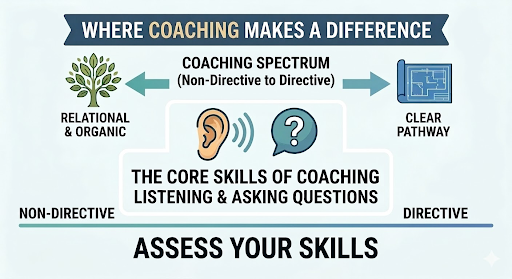
Think of disciple-making as a continuum. On one end, you have the NON-DIRECTIVE approach—it’s fluid, relational, and spontaneous. On the other end, you have a DIRECTIVE —a clear, step-by-step map of what a disciple needs to be and do.
Regardless of where you land on that scale, there are two “superpower” skills that make the difference between a nice chat and a life-changing transformation: Listening well and asking the right questions.
Where Coaching Comes In
This is where the art of coaching meets the heart of discipleship. It’s about helping someone else hear from the Holy Spirit, rather than just giving them all the answers.
When we stop “telling,” and start “asking,” we create space for people to own their own growth. It simplifies the process, and makes it a lot more human.
Curious about how you’re doing in this area?
I’ve put together a simple quiz to help you assess your ability to help others listen to and discern the voice of the Holy Spirit. No matter what your specific “pathway” looks like, these insights will help you sharpen your focus.
TAKE THE QUIZ HERE
I know how heavy the weight of leadership can feel, especially when your heart is for people, but your schedule is full of “programs.” It’s okay to admit that the mission feels daunting or that you’ve felt stuck in the complexity of it all. Please hear this: you don’t have to have all the answers to be a great disciple-maker; you just have to be willing to sit with someone, listen deeply, and point them toward the Father. You’re not alone in this journey, and even a small shift in how you listen can spark a massive shift in how others grow. We’re in this together, and I truly believe the best days of your ministry are ahead as you lean into these simple, life-giving connections.
by Gary Reinecke | Mar 4, 2026 | Uncategorized |
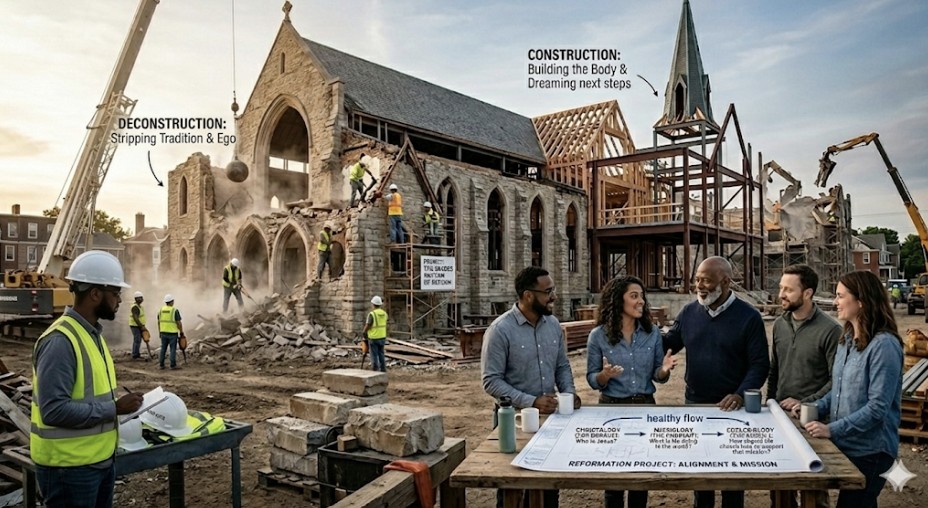
It feels like we’re standing in the middle of a construction site together, doesn’t it? There is a beautiful, albeit messy, tension in the air right now. On one hand, we are constructing—building up the body and dreaming about what comes next. On the other hand, we are deconstructing—stripping away the layers of tradition, ego, and the “way we’ve always done it” to find that original, solid foundation.
I’ll be the first to admit that I’ve been looking deeply at how we “do” church in our current world. This isn’t a new conversation; there have been endless blogs, books, and podcasts on the topic. In fact, since I’ve been blogging on coaching for disciple-making and church multiplication since 2008, I sometimes feel like I’m just trying to keep up with the pace of the dialogue.
In this landscape, we often see two camps: the attractional (the classical or dominant model) and the missional (the house, micro, or organic models). It’s so easy to criticize one to make the other feel superior, or to argue over which one is more “incarnational” or closely connected to how Jesus ministered. And if one is simply adding versus multiplying disciples, leaders, and churches.
But regardless of which “camp” we find ourselves in, I believe it is good and right for us to periodically pause and ask the hard questions:
- Does our Ecclesiology (how we do church) flow from our Missiology (what we are called to do)?
- And does our Missiology flow directly from our Christology (who Jesus is)?
One of the reasons I am personally looking so closely at the house church movement is to see if it is genuinely reaching people that the dominant model just can’t seem to get to, and if disciple-making movements are multiplying into the third, fourth, and fifth generations. The research I’ve read leans heavily in that direction, which, to be honest, is a bit disconcerting. After giving nearly four decades of my life to supporting the dominant church model, it’s a vulnerable place to be.
We’re in this together, and I’m curious—where are you finding that “original foundation” in your own journey?
The Sacred Rhythm of Reform
The church is a living thing, which means it’s always breathing, growing, and—let’s be honest—occasionally needing a major heart transplant. History calls this Reformation. It’s never comfortable. It usually feels like a crisis before it feels like a breakthrough.
Are we in one of those “Great Reformation” moments right now? It certainly feels like the ground is shifting. But maybe that’s a good thing. Maybe the “shaking” is just God’s way of helping us find our center again.
Getting the Flow Right
To build something that actually lasts, we have to look at the “plumbing” of our faith. When the water flows in the right direction, everything stays hydrated. When it gets backed up, things start to… well, smell a bit off.
The healthy flow looks like this:
- Christology (The Source): Who is Jesus? Everything starts here. Not the “stained-glass” version of Jesus, but the radical, foot-washing, table-turning, grace-giving King.
- Missiology (The Current): What is He doing in the world? If we know who He is, we’ll see where He’s going. He’s already out there—healing, reconciling, and loving. Our job is to catch up.
- Ecclesiology (The Vessel): How should the church look to support that mission? This is the “shape” we take to hold the mission.
The Red Flag: When we get this backwards—starting with Ecclesiology (how we want our church to look)—we end up trying to squeeze Jesus into our brand. We build the “vessel” first, and then wonder why the Spirit feels so cramped.
When we return to the original order, we often find that the church looks a lot less like a polished institution, and a lot more like that ragtag, dusty, brilliant community Jesus called into existence with His original twelve.
Reflection Questions
Let’s lean into curiosity for a moment. Grab a coffee, find a quiet spot, and sit with these:
- The Mirror Test: If our church’s current structure (Ecclesiology) were the only “map” someone had, would it actually lead them to the real Jesus (Christology)?
- The Neighborhood Watch: If we stopped looking at our internal “to-do” list and looked at our city instead, what is Jesus already doing there that we’ve been too busy to notice?
- The Demo Crew: What is one “image” of the church you’ve been holding onto that might actually be getting in the way of the mission? Are you brave enough to let it go?
Multiplication Evaluation
Are you curious about multiplication? I received permission to synthesize this list from “Becoming a Level 5IVE Multiplying Church Field Guide” by Todd Wilson, Dave Ferguson, with Alan Hirsch. In addition, I created a simple evaluation for your use that is available here.