One of the most beautiful gifts of the liturgical church is the rhythm of the church calendar. There is such a deep, grounded strength in following the steps of those who walked before us. Over the years, we’ve come to truly treasure the intricacies of Holy Week—those historical touchpoints that help us remember who we are and whose we are.
We’ve gained so much by simply taking the time to slow down, reflect, and lean into a community of others on that same journey. Whether it’s the quiet reverence of Good Friday or the pure joy of Easter Sunday, these moments anchor us.
When we were raising our young children, we viewed Holy Week as a vital way to show them God’s faithfulness in “real-time.” I have to give all the credit to Gina for the incredible effort and heart she put into preparing for our Seder meals. We did our best to set a meaningful tone, hunt down the right ingredients, and create an experience that felt both fun for the kids and truly holy for all of us.
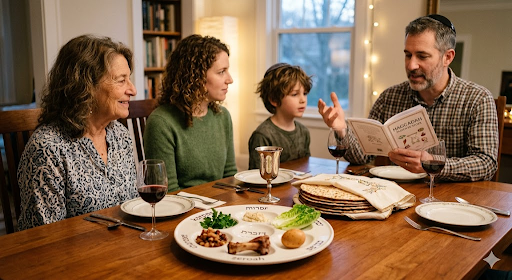
Is your church or community observing a Seder Meal this year? If you’re looking to bring this tradition into your own home or join with others, here is a streamlined guide to help you host or participate in a Seder that honors the story of the Exodus.
1. The Essentials: The Seder Plate
The Seder plate is the heart of the table. It holds six symbolic items that serve as a “sensory map” for the story:
Item
Name
Symbolism
Karpas
Parsley/Greenery
Springtime and hope; dipped in salt water (tears).
Maror
Bitter Herbs
The bitterness of slavery (usually horseradish).
Chazeret
Second Bitter Herb
Often, romaine lettuce; used in the “Hillel Sandwich.”
Charoset
Fruit & Nut Paste
Represents the mortar used by Israelite slaves.
Zeroah
Roasted Bone
Symbolizes the Paschal sacrifice (a beet can be used for vegetarians).
Beitzah
Roasted Egg
Symbolizes the cycle of life and festival offerings.
Quick Tip: Don’t forget three pieces of Matzah (unleavened bread) stacked and covered, and enough wine or grape juice for everyone to enjoy the traditional four cups.
2. The Haggadah (The Script)
The Haggadah is the book that guides you through the evening. Interestingly, “Seder” actually translates to “Order”—and there are 15 specific steps that help the story unfold:
Kadeish: Sanctification (The 1st cup of wine).
Urchatz: Washing the hands (without a blessing).
Karpas: Dipping the green vegetable in salt water.
Yachatz: Breaking the middle matzah. The larger piece becomes the Afikoman (hide this for the kids to find later!).
Maggid: Telling the story. This is where the youngest person asks the Four Questions.
Rachtzah: Washing the hands (with a blessing).
Motzi Matzah: The blessing over the matzah.
Maror: Tasting the bitter herbs.
Koreich: Enjoying the “Hillel Sandwich” (matzah, maror, and charoset).
Shulchan Oreich: The main festive meal—time to eat!
Tzafun: Finding and eating the Afikoman.
Bareich: Grace after the meal (The 3rd cup of wine).
Hallel: Singing songs of praise (The 4th cup of wine).
Nirtzah: The conclusion—”Next year in Jerusalem!”
3. Creating the Atmosphere
Remember, a Seder is meant to be engaging and relaxed, not stiff! In ancient tradition, people actually reclined while drinking their wine to show they were no longer slaves, but free people at rest.
The Four Questions: If you have children at the table, lean into their curiosity. The Seder is designed to be a hand-off of faith to the next generation.
The Cup of Elijah: We fill a cup and open the door to symbolically welcome the prophet Elijah, representing our hope for future redemption.
The Ten Plagues: As you name each plague, it’s traditional to dip a finger in your wine and place a drop on your plate. It’s a somber, beautiful moment of empathy, acknowledging that our joy is lessened because others suffered for our freedom.
In a traditional Seder, the youngest child asks why this night is different from all other nights. Here is a simplified, kid-friendly version you can print out or practice with them:
The Four Questions: Why is this night different?
On all other nights, we eat bread or crackers. Why on this night do we only eat Matzah?
The Answer: Because our ancestors had to leave Egypt so quickly, their bread didn’t have time to rise!
On all other nights, we eat all kinds of vegetables. Why on this night do we eat “Maror” (bitter herbs)?
The Answer: To help us remember how bitter and hard it was to be slaves in Egypt.
On all other nights, we don’t usually dip our food. Why on this night do we dip our food twice?
The Answer: We dip parsley in salt water to remember tears, and we dip bitter herbs into sweet charoset to remember that even in hard times, there is hope.
On all other nights, we sit up straight at the table. Why on this night do we recline and lean on pillows?
The Answer: Because once we were slaves, but now we are free! Reclining was a sign of being a free person in the ancient world.
A Classic Seder Menu
The Starter: Matzah Ball Soup, known affectionately as “Jewish Penicillin.” These are fluffy (or dense, depending on your family preference!) dumplings served in a clear, rich chicken broth with carrots and celery.
The Main: Slow-Roasted Beef Brisket. This is the star of the show. Brisket is perfect for a Seder because it’s braised slowly with onions, carrots, and often a bit of tomato or red wine, making it incredibly tender. Plus, it’s even better when made a day ahead!
The Side: Potato Kugel. Think of this as a savory, shredded potato casserole. It’s crispy on the edges and soft in the middle—the ultimate comfort food that pairs perfectly with the brisket gravy.
The Vegetable: Roasted Tzimmes A colorful dish of roasted honey-glazed carrots and sweet potatoes, often tossed with dried plums (prunes) or apricots. It adds a lovely sweetness to the plate.
The Sweet Finish: Flourless Chocolate Cake or Macaroons Since we don’t use flour (leavening) during Passover, a rich, dense chocolate cake or chewy coconut macaroons are the traditional way to end the night on a high note.
A Few Tips for a Kid-Friendly Seder Meal:
The Reward: Since the kids have to wait through the first part of the Seder to get to the meal, many families have a small “treat” or prize ready for the child who finds the Afikoman (the hidden piece of Matzah) later in the night. It keeps the energy high!
Let them Recline: If you want to make it “fun yet holy”, let the kids bring their favorite pillows to the dinner table. It’s a great visual for them to understand the difference between “slavery” and “rest.”
One thing that makes the Seder meal unique is the timing. Because the “storytelling” (the Maggid) happens before the meal, guests can sometimes get a little “hangry” waiting for the brisket!
Have small bowls of salt water and extra parsley (Karpas) or even some plain nuts and dried fruit already on the table. It gives everyone something to nibble on while you’re going through the Hagaddah steps before the main course is served.
Ultimately, the Seder is more than just a meal; it is a living bridge between the past and the future. By making the effort to gather, to lean into the symbols, and to invite our children to ask their questions, we aren’t just recounting history—we are practicing faithfulness. Whether your table is perfectly set or beautifully chaotic, remember that the “holiness” of the evening comes from the shared journey and the quiet reminder that God is, and always has been, a deliverer. As you lift your cups and break the matzah this year, may you find fresh joy in the rhythm of the calendar and the enduring hope of the story we tell together.
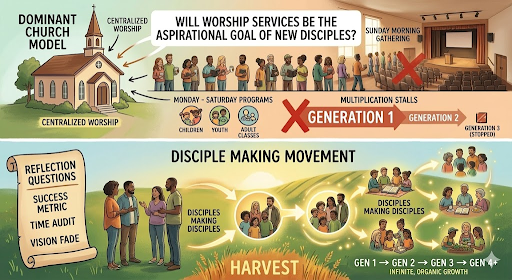
It’s the place where many of us found our faith, raised our kids, and built lifelong friendships. Whether you call it the “dominant,” “centralized,” or “classical” model, the typical Sunday-morning-gathering-plus-weekly-programs approach has been the heartbeat of spiritual life in the West for generations. It’s a good model, and it has served us well.
But here’s the rub: if that model starts to dream of a “Disciple- Making Movement” (DMM)—where disciples make disciples down to the third and fourth generations—it eventually hits a wall. And that wall isn’t just a minor hurdle; it’s a fundamental challenge to how we think about “doing church.”
The Reality of the “Slow” Harvest
I was catching up last week with a leader who has been waist-deep in the harvest since 2012. He’s spent over a decade deconstructing and reconstructing what it actually looks like to plant churches that multiply. It’s gritty work. It’s slow—at least for the first ten years.
He told me about a season where he and a teammate helped launch 30 churches in a single year. But when the dust settled? Only four groups remained, and only three of those self-identified as “churches.” He was honest about the internal toll that takes: the self-doubt, the seasons of fruitlessness, and the subtle (or not-so-subtle) pressure from friends and family to just go back to the “normal” way of doing things.
The Make-or-Break Question
I asked him point-blank: “What is the single greatest challenge for an existing church trying to adopt a movement approach?”
His answer was as simple as it was provocative. It all comes down to permission.
Are leaders willing to let disciple-making groups stay in the harvest? Are they okay with new disciples never attending a traditional Sunday worship service?
He’s observed a consistent pattern: if a church—consciously or unconsciously—expects new disciples to eventually “show up to the campus” for a service, the reproduction stalls. It rarely makes it past the second generation.
Why the Momentum Stalls
When a worship service becomes the ultimate “aspirational goal” for a new believer, the movement naturally begins to plateau. Here are three reasons why:
A Shift in Focus: New disciples stop looking outward at the harvest and start looking inward at the stage. They move from being “active players” to “engaged spectators.”
The Margin Squeeze: Between Sunday services, mid-week programs, and volunteer rotations, new believers find they have less and less time to actually sit with their unchurched neighbors.
Comfort Over Commission: Once a new disciple’s needs are being met by the church’s excellent programming, the urgency to reach others often fades. The “vision” is replaced by “satisfaction.”
It’s a sobering thought for those of us who love the local church: Is our current definition of “success” actually the very thing standing in the way of a movement?
That’s a brave step. Identifying these blockages is one thing, but sitting with the discomfort of how they challenge our current leadership habits is where the real growth happens.
To help you and your team lean into this, here are five reflection questions designed to bridge the gap between the “Dominant Model” and a “Disciple-Making Movement.”
Reflection Questions for Leaders
The “Success” Metric: If a group of ten new disciples met in a home for two years, multiplied into two more groups, and never once stepped foot on your campus, would you consider that a win for your church? Why or why not?
The Time Audit: Look at the calendar of your most “committed” members. How much of their time is spent inside church-sponsored activities versus in the harvest with people who don’t know Jesus? Does our current programming create or consume margin?
The Aspirational Goal: When we share testimonies or “success stories” from the stage, are we celebrating people who have joined a ministry team, or people who have started a discovery group in their workplace? What does that tell our congregation about what “mature” discipleship looks like?
The “Attachment” Factor: Is our system designed to attach people to a Person (Jesus), a People (the harvest/community), or a Place (the building)? Which of those three is the easiest to replicate to the fourth generation?
The Permission Gap: What specific “rules” or “expectations” (unspoken or otherwise) would we have to waive to allow a movement to stay in the harvest? Are we willing to let go of the need to “count” them in our Sunday attendance?
A Final Thought
The goal isn’t to tear down the “Sunday Celebration”—there is beauty and power in the gathering of the saints. The goal is to ensure the gathering serves the movement, rather than the movement serving the gathering.
Fuel for the Movement
Dive deeper into the shift from ministry models to multiplying movements.
Featured Resource:7 Practices of Disciple Making Churches: New Research on What Works in North America. This book is worth reading if you are interested in how disciple-making movements are happening in North America. Bobby Harrington and Josh Howard have identified seven common practices from a handful of churches in the North American context that are actually multiplying disciples into the third, fourth, and fifth generations.
Multiplication Evaluation
Are you curious about multiplication? I received permission to synthesize this list from “Becoming a Level 5IVE Multiplying Church Field Guide” by Todd Wilson, Dave Ferguson, with Alan Hirsch. In addition, I created a simple evaluation for your use that is available here.
I recently had the privilege of sitting in on a webinar with Brent O’Bannon, hosted by the Professional Christian Coaching Institute. Brent has this incredible depth of wisdom when it comes to the Gallup StrengthsFinder, but what really stopped me in my tracks was how he applied his insights to the way we build relationships.
He shared three “rules” for how we interact with others, and I couldn’t help but see how perfectly they fit into our mission of making disciples.
The Three Rules of Connection*
The Golden Rule: Treat others the way you want to be treated. (The classic foundation!)
The Platinum Rule: Treat others the way they want to be treated. (Meeting them where they are.)
The Diamond Rule: Embracing the absolute uniqueness of your “disciple” just as much as you embrace your own. It’s not one at the expense of the other; it’s holding and honoring both identities at the same time.
*Used with permission.
Raising the Standard
As I’ve reflected on this Diamond Rule, I’ve been wondering: What if our disciple-making environments were defined by this kind of depth? Imagine how much more powerful our work in the Harvest could become if we raised the bar for how we engage with the world. Wouldn’t it be something if people far from God started describing Christians as “the most respectful listeners I’ve ever met”? That would be a beautiful kind of “jarring.”
Listening in the Chair
The truth is, it’s hard to truly put ourselves in someone else’s shoes if we’ve never carried their specific burden.
For the past year, every four weeks, I visit “Polly” (not her real name) to get my hair cut. Each time I sit in her chair, she shares the heavy reality of her husband’s life—the partial paralysis, the chronic headaches, and the grief following a brain surgery that didn’t go as planned. Barring a miracle, this is their “new normal.”
In that chair, my best tool isn’t catchy Christian phrases or a sermon; it’s asking questions and truly listening. Last month, after hearing the latest update, I simply asked if I could pray for her. She didn’t hesitate.
I prayed quietly, empathetically, and respectfully. Prayer is many things: a way to talk to God, a demonstration of care, and a weapon to push back the darkness. But to pave the way for that prayer, I had to apply the Diamond Rule first—building a bridge of trust by honoring exactly who Polly is at that moment.
Bringing Out the “Diamond” in Your Disciple
The next time you’re in a conversation and find yourself struggling to move from your own perspective to a “Diamond” level of connection, try asking yourself these five questions:
How can I raise my level of engagement with the person right in front of me?
What does this person need at this moment?
What do I need?
What can I set aside to get out of my own way?
How can I show total respect to them while staying true to who God made me to be?
I know that wanting to see the “Diamond” in someone else often comes from a place of deep, quiet secondary burden—you carry the weight of wanting them to feel fully seen, known, and loved by God. It can feel vulnerable to step into those messy, unscripted spaces where you don’t have all the answers and can only offer your presence. Please give yourself grace as you navigate these conversations; it’s a journey of the heart, not a checklist to master. Your genuine desire to honor another person’s uniqueness while staying true to your own calling is exactly how the light of Christ begins to break through. You aren’t just making a disciple; you’re offering a rare kind of dignity for which the world is starving.
Becoming a “Bi-Directional” Listener
The goal is to become a listener who looks two ways at once: tuning in deeply to the person in front of you, while simultaneously discerning the whisper of the Holy Spirit.
How is your “Bi-Directional” listening? I’ve put together a quick 5-minute quiz to help you see where you are and create a personal growth plan.
[CLICK HERE to take the Bi-Directional Listener Quiz]
I was catching up with a pastor friend the other day, and he dropped a truth bomb that stopped me in my tracks. He looked at me and said:
“How can I expect my people to make disciples when I’m not doing it myself?”
That kind of honesty is refreshing, isn’t it? But it also pulls back the curtain on a struggle so many of us feel. It got me thinking: If the “Great Commission” is our primary bread and butter, why does it often feel like a side dish?
What’s Really Standing in the Way?
Before we can find a way forward, we have to be honest about the hurdles. Usually, it boils down to three simple (but stubborn) things:
The “Definition” Deficit: We haven’t landed on a clear, shared picture of what a disciple actually looks like.
The “How-To” Hesitation: We aren’t quite sure what it actually takes to walk alongside someone.
The Complexity Trap: We’ve made the process so academic or intimidating that people feel they need a PhD just to grab coffee and talk about Jesus.
Finding the Sweet Spot
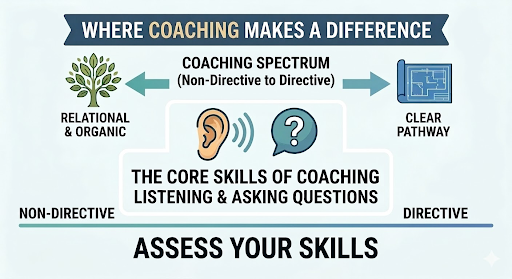
Think of disciple-making as a continuum. On one end, you have the NON-DIRECTIVE approach—it’s fluid, relational, and spontaneous. On the other end, you have a DIRECTIVE —a clear, step-by-step map of what a disciple needs to be and do.
Regardless of where you land on that scale, there are two “superpower” skills that make the difference between a nice chat and a life-changing transformation: Listening well and asking the right questions.
Where Coaching Comes In
This is where the art of coaching meets the heart of discipleship. It’s about helping someone else hear from the Holy Spirit, rather than just giving them all the answers.
When we stop “telling,” and start “asking,” we create space for people to own their own growth. It simplifies the process, and makes it a lot more human.
Curious about how you’re doing in this area?
I’ve put together a simple quiz to help you assess your ability to help others listen to and discern the voice of the Holy Spirit. No matter what your specific “pathway” looks like, these insights will help you sharpen your focus.
I know how heavy the weight of leadership can feel, especially when your heart is for people, but your schedule is full of “programs.” It’s okay to admit that the mission feels daunting or that you’ve felt stuck in the complexity of it all. Please hear this: you don’t have to have all the answers to be a great disciple-maker; you just have to be willing to sit with someone, listen deeply, and point them toward the Father. You’re not alone in this journey, and even a small shift in how you listen can spark a massive shift in how others grow. We’re in this together, and I truly believe the best days of your ministry are ahead as you lean into these simple, life-giving connections.
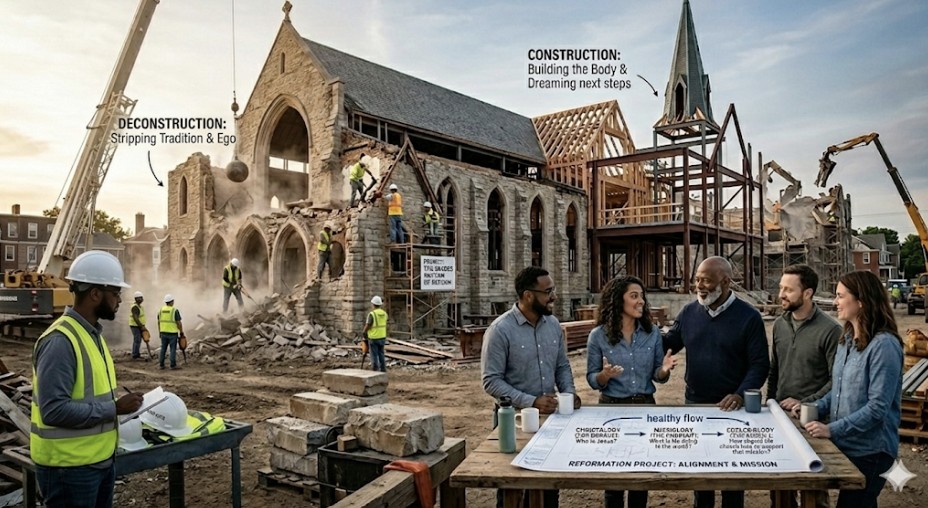
It feels like we’re standing in the middle of a construction site together, doesn’t it? There is a beautiful, albeit messy, tension in the air right now. On one hand, we are constructing—building up the body and dreaming about what comes next. On the other hand, we are deconstructing—stripping away the layers of tradition, ego, and the “way we’ve always done it” to find that original, solid foundation.
I’ll be the first to admit that I’ve been looking deeply at how we “do” church in our current world. This isn’t a new conversation; there have been endless blogs, books, and podcasts on the topic. In fact, since I’ve been blogging on coaching for disciple-making and church multiplication since 2008, I sometimes feel like I’m just trying to keep up with the pace of the dialogue.
In this landscape, we often see two camps: the attractional (the classical or dominant model) and the missional (the house, micro, or organic models). It’s so easy to criticize one to make the other feel superior, or to argue over which one is more “incarnational” or closely connected to how Jesus ministered. And if one is simply adding versus multiplying disciples, leaders, and churches.
But regardless of which “camp” we find ourselves in, I believe it is good and right for us to periodically pause and ask the hard questions:
Does our Ecclesiology (how we do church) flow from our Missiology (what we are called to do)?
And does our Missiology flow directly from our Christology (who Jesus is)?
One of the reasons I am personally looking so closely at the house church movement is to see if it is genuinely reaching people that the dominant model just can’t seem to get to, and if disciple-making movements are multiplying into the third, fourth, and fifth generations. The research I’ve read leans heavily in that direction, which, to be honest, is a bit disconcerting. After giving nearly four decades of my life to supporting the dominant church model, it’s a vulnerable place to be.
We’re in this together, and I’m curious—where are you finding that “original foundation” in your own journey?
The Sacred Rhythm of Reform
The church is a living thing, which means it’s always breathing, growing, and—let’s be honest—occasionally needing a major heart transplant. History calls this Reformation. It’s never comfortable. It usually feels like a crisis before it feels like a breakthrough.
Are we in one of those “Great Reformation” moments right now? It certainly feels like the ground is shifting. But maybe that’s a good thing. Maybe the “shaking” is just God’s way of helping us find our center again.
Getting the Flow Right
To build something that actually lasts, we have to look at the “plumbing” of our faith. When the water flows in the right direction, everything stays hydrated. When it gets backed up, things start to… well, smell a bit off.
The healthy flow looks like this:
Christology (The Source):Who is Jesus? Everything starts here. Not the “stained-glass” version of Jesus, but the radical, foot-washing, table-turning, grace-giving King.
Missiology (The Current):What is He doing in the world? If we know who He is, we’ll see where He’s going. He’s already out there—healing, reconciling, and loving. Our job is to catch up.
Ecclesiology (The Vessel):How should the church look to support that mission? This is the “shape” we take to hold the mission.
The Red Flag: When we get this backwards—starting with Ecclesiology (how we want our church to look)—we end up trying to squeeze Jesus into our brand. We build the “vessel” first, and then wonder why the Spirit feels so cramped.
When we return to the original order, we often find that the church looks a lot less like a polished institution, and a lot more like that ragtag, dusty, brilliant community Jesus called into existence with His original twelve.
Reflection Questions
Let’s lean into curiosity for a moment. Grab a coffee, find a quiet spot, and sit with these:
The Mirror Test: If our church’s current structure (Ecclesiology) were the only “map” someone had, would it actually lead them to the real Jesus (Christology)?
The Neighborhood Watch: If we stopped looking at our internal “to-do” list and looked at our city instead, what is Jesus already doing there that we’ve been too busy to notice?
The Demo Crew: What is one “image” of the church you’ve been holding onto that might actually be getting in the way of the mission? Are you brave enough to let it go?
Multiplication Evaluation
Are you curious about multiplication? I received permission to synthesize this list from “Becoming a Level 5IVE Multiplying Church Field Guide” by Todd Wilson, Dave Ferguson, with Alan Hirsch. In addition, I created a simple evaluation for your use that is available here.
Reflections from the So Cal Multiply Conference: More than a Model
For the last couple of weeks, I’ve been sharing an invitation to the So Cal Multiply Conference, and after spending time with Brian Johnson from KC Underground, I’m still processing the depth of what was shared.
Rather than a dry summary of points, I want to share the heart of what I took away. If you want the deep dive into the “how-to,” I highly recommend checking out their Missionary Pathway Toolkit. But for now, here are the five shifts that are currently rattling around in my soul:
1. The Banner Over Everything: Jesus is Lord
It sounds simple, right? But Brian challenged us to consider if everything—our strategies, our budgets, and our very lives—actually falls under the banner of “Jesus is Lord.” If He is truly the center, then the pressure is off of us to “perform” and back on us to simply obey.
My takeaway: The term “deconstruction” carries negative connotations in our Christian church and community conversations today. In a positive light, however, it is helpful to willingly offer our lives and ministries to Jesus so that He can strip away those aspects that are not under his lordship. This has been painful for me – but worth it!
2. The Disciple-Maker’s Rhythm
We often look for a “silver bullet” for church growth, but the pathway shared at the conference felt much more like a natural, living rhythm. It starts and ends with Extraordinary Prayer and Fasting.
From that place of spiritual intensity, we move through a beautiful progression:
Incarnational Mission: Being present where people actually live.
Planting the Gospel: Letting the Word take root in new soil.
The Church Emerges: Watching a spiritual family form naturally.
Multiplication: Doing it again, and again.
My takeaway: I love the simplicity; however, I don’t have a habit of practicing the first and most important rhythm of Extraordinary Prayer and Fasting, which explains a lot of things…
3. Redefining the “Ordinary.”
One of the most refreshing parts of the weekend was the language used to describe the work. We aren’t looking for “super-pastors”; we are looking for ordinary people.
The Disciple-Maker: Just an ordinary person who plants themselves in an unreached network to love people and share the Gospel.
The Microchurch: Not a “mini-service,” but an extended spiritual family (an oikos) of 10-25 people doing life together.
The Collective: This is the “connective tissue” that shares resources, governing elders, mission, and larger gatherings (sometimes).
Hub Team: A catalytic team that exists to equip, coach, and convene disciple-makers and MCs within a geographic area or affinity.
My takeaway: An upside-down triangle was the image used to illustrate the Disciple-Maker at the top and the Hub Team at the bottom. The purpose? The Hub Team supports the three layers above with the Disciple-Maker at the top on the front lines, working in the Harvest.
4. Getting the Flow Right
This was a “lightbulb moment” for me – one that I have heard and read about from Alan Hirsch, author of The Forgotten Ways, Reactivating Apostolic Movements, before, but it hit me differently at the conference. If we start with Ecclesiology (how we do church), we often end up stuck in tradition, but if we follow the proper flow, everything changes:
Christology (Who is Jesus?) → Missiology (What is He doing in the world?) → Ecclesiology (How should the church look to support that mission?)
My takeaway: When our view of Jesus is big enough, it dictates our mission, which then dictates what the church looks like.
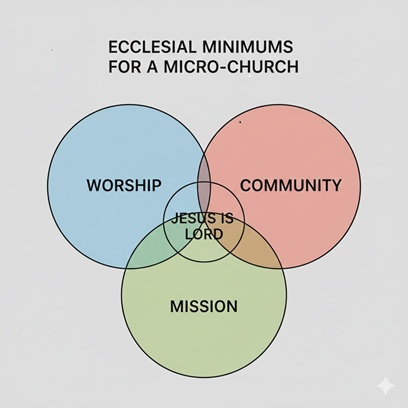
5. The “Ecclesial Minimums.”
We often overcomplicate what it means to be “The Church.” Brian stripped it back to a simple Venn diagram. At the center is Jesus is Lord, and where these three circles overlap, the church exists:
Worship: Our devotion to God.
Community: Our devotion to one another.
Mission: Our devotion to the world.
My takeaway: this is a helpful tool to assess the health of a micro-church; ideally, each circle is in balance with the other – see image above. When one is larger than the others, the MC coach asks the MC leader, “How can you bring balance?”
A Question for the Road
As I look back on the weekend, one question keeps rising to the surface:
How well are we doing at seeing the church fill everything in every way? If the church isn’t just a building on the corner, but a people scattered into every neighborhood, hobby group, and workplace, the possibilities for multiplication are endless.
Multiplication Evaluation
Are you curious about multiplication? I received permission to synthesize this list from “Becoming a Level 5IVE Multiplying Church Field Guide” by Todd Wilson, Dave Ferguson, with Alan Hirsch. In addition, I created a simple evaluation for your use that is available here.
We use cookies to optimize our website and our service.
Functional
Always active
The technical storage or access is strictly necessary for the legitimate purpose of enabling the use of a specific service explicitly requested by the subscriber or user, or for the sole purpose of carrying out the transmission of a communication over an electronic communications network.
Preferences
The technical storage or access is necessary for the legitimate purpose of storing preferences that are not requested by the subscriber or user.
Statistics
The technical storage or access that is used exclusively for statistical purposes.The technical storage or access that is used exclusively for anonymous statistical purposes. Without a subpoena, voluntary compliance on the part of your Internet Service Provider, or additional records from a third party, information stored or retrieved for this purpose alone cannot usually be used to identify you.
Marketing
The technical storage or access is required to create user profiles to send advertising, or to track the user on a website or across several websites for similar marketing purposes.