
Reflections from the So Cal Multiply Conference: More than a Model
For the last couple of weeks, I’ve been sharing an invitation to the So Cal Multiply Conference, and after spending time with Brian Johnson from KC Underground, I’m still processing the depth of what was shared.
Rather than a dry summary of points, I want to share the heart of what I took away. If you want the deep dive into the “how-to,” I highly recommend checking out their Missionary Pathway Toolkit. But for now, here are the five shifts that are currently rattling around in my soul:
1. The Banner Over Everything: Jesus is Lord
It sounds simple, right? But Brian challenged us to consider if everything—our strategies, our budgets, and our very lives—actually falls under the banner of “Jesus is Lord.” If He is truly the center, then the pressure is off of us to “perform” and back on us to simply obey.
My takeaway: The term “deconstruction” carries negative connotations in our Christian church and community conversations today. In a positive light, however, it is helpful to willingly offer our lives and ministries to Jesus so that He can strip away those aspects that are not under his lordship. This has been painful for me – but worth it!
2. The Disciple-Maker’s Rhythm
We often look for a “silver bullet” for church growth, but the pathway shared at the conference felt much more like a natural, living rhythm. It starts and ends with Extraordinary Prayer and Fasting.
From that place of spiritual intensity, we move through a beautiful progression:
- Incarnational Mission: Being present where people actually live.
- Planting the Gospel: Letting the Word take root in new soil.
- The Church Emerges: Watching a spiritual family form naturally.
- Multiplication: Doing it again, and again.
My takeaway: I love the simplicity; however, I don’t have a habit of practicing the first and most important rhythm of Extraordinary Prayer and Fasting, which explains a lot of things…
3. Redefining the “Ordinary.”
One of the most refreshing parts of the weekend was the language used to describe the work. We aren’t looking for “super-pastors”; we are looking for ordinary people.
- The Disciple-Maker: Just an ordinary person who plants themselves in an unreached network to love people and share the Gospel.
- The Microchurch: Not a “mini-service,” but an extended spiritual family (an oikos) of 10-25 people doing life together.
- The Collective: This is the “connective tissue” that shares resources, governing elders, mission, and larger gatherings (sometimes).
- Hub Team: A catalytic team that exists to equip, coach, and convene disciple-makers and MCs within a geographic area or affinity.
My takeaway: An upside-down triangle was the image used to illustrate the Disciple-Maker at the top and the Hub Team at the bottom. The purpose? The Hub Team supports the three layers above with the Disciple-Maker at the top on the front lines, working in the Harvest.
4. Getting the Flow Right
This was a “lightbulb moment” for me – one that I have heard and read about from Alan Hirsch, author of The Forgotten Ways, Reactivating Apostolic Movements, before, but it hit me differently at the conference. If we start with Ecclesiology (how we do church), we often end up stuck in tradition, but if we follow the proper flow, everything changes:
Christology (Who is Jesus?) → Missiology (What is He doing in the world?) → Ecclesiology (How should the church look to support that mission?)
My takeaway: When our view of Jesus is big enough, it dictates our mission, which then dictates what the church looks like.
5. The “Ecclesial Minimums.”
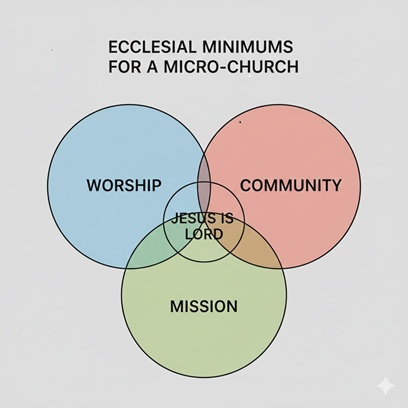
We often overcomplicate what it means to be “The Church.” Brian stripped it back to a simple Venn diagram. At the center is Jesus is Lord, and where these three circles overlap, the church exists:
- Worship: Our devotion to God.
- Community: Our devotion to one another.
- Mission: Our devotion to the world.
My takeaway: this is a helpful tool to assess the health of a micro-church; ideally, each circle is in balance with the other – see image above. When one is larger than the others, the MC coach asks the MC leader, “How can you bring balance?”
A Question for the Road
As I look back on the weekend, one question keeps rising to the surface:
How well are we doing at seeing the church fill everything in every way? If the church isn’t just a building on the corner, but a people scattered into every neighborhood, hobby group, and workplace, the possibilities for multiplication are endless.
Multiplication Evaluation
Are you curious about multiplication? I received permission to synthesize this list from “Becoming a Level 5IVE Multiplying Church Field Guide” by Todd Wilson, Dave Ferguson, with Alan Hirsch. In addition, I created a simple evaluation for your use that is available here.
