
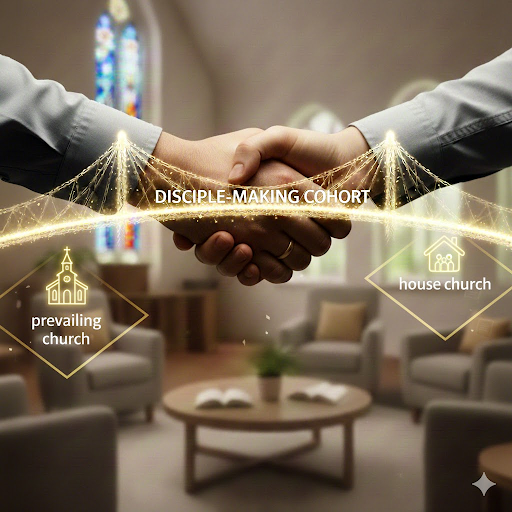
Bridging the Divide: How “Disciple-Making Cohorts” Can Open Doors for the Micro-Church Movement
I was having a conversation with a respected church leader the other day, and we were discussing the future of the church and various ministry models. As the conversation naturally drifted towards smaller, more intimate gatherings, I found myself using terms like “micro-church” and “house church.”
It was subtle at first, but then it became undeniable. I watched as a visible shift occurred in his demeanor. A flicker of skepticism, then a tightening around his eyes. The friendly, open conversation began to stiffen. It was a visceral response, almost as if an invisible wall had materialized between us. While he remained polite, his body language communicated a clear message: “This will not work here!”
It was a stark reminder of the ingrained biases many hold when it comes to the classic, traditional church model. For some, the terms “micro-church” or “house church” conjure images of something less-than, unorganized, or even (Dare I say it?) a bit rebellious. It’s a knee-jerk reaction, born from years of experience and a deep-seated commitment to what they know and believe works.
This experience got me thinking: how can we communicate the incredible value and biblical foundation of these smaller, more relational expressions of faith without immediately triggering that defensive response? How can we speak to those who are resistant or closed to the idea, without them shutting down before we’ve even had a chance to share the vision?
The answer, I believe, lies in our language.
Instead of terms that can evoke preconceived notions, what if we adopted language that emphasizes the core mission and value proposition of these gatherings? What if we shifted from “micro-church,” “house church,” “missional community,” or even “organic church” to something like “Disciple-Making Cohort”? I give my friend Dennis Bachman (Via Cordis, house church network leader) credit for the term.
Think about the implications of that term.
- “Disciple-Making” immediately grounds the conversation in the Great Commission. It highlights the primary purpose of these gatherings: to make and mature followers of Jesus. It speaks to intentional growth, learning, and transformation. Ultimately, the fruit of a disciple is other disciples, making disciples – multiplication!
- “Cohort” implies a dedicated group, a focused journey, and a sense of shared purpose. It sounds intentional, structured (even if organically so), and collaborative. It removes the ambiguity that “house church” might have for some, suggesting a casual gathering rather than a committed community. And avoids the negative connotation of “micro-churches” being ingrown, closed to outsiders, and just plain weird!
A “Disciple-Making cohort” immediately communicates intentionality, spiritual growth, and community. It focuses on the what and the why rather than the how or the where. It emphasizes the core biblical mandate of following Jesus and helping others do the same, which is something every church leader, regardless of their preferred model, can get behind.
This isn’t about abandoning our convictions or hiding what we do. It’s about strategic communication. It’s about finding common ground and building bridges of understanding. When we use language that resonates with the values and priorities of those we’re trying to reach, we open doors that might otherwise remain firmly shut.
Imagine starting a conversation about forming “Disciple-Making cohorts” with that church leader. The immediate visual isn’t a potentially unkempt living room, but rather a group of committed individuals earnestly pursuing spiritual growth together. The visceral response of “this will not work here!” is much less likely. Instead, it invites questions, curiosity, and perhaps even a shared vision for making disciples in a new and effective way.
As leaders involved in micro-church and house church movements, passion is evident. But sometimes, that passion needs to be tempered with strategic communication. Let’s consider how we can effectively share the transformative power of these smaller, nimble expressions of faith with those who currently see them through a lens of resistance.
Reflection Questions for Micro-Church/House Church Leaders:
- What terms do you currently use to describe your ministry, and what perceptions might those terms evoke in someone unfamiliar or resistant to the concept?
- How can you articulate the core mission and values of your “micro-church” in a way that resonates with the biblical mandates that traditional church leaders also uphold?
- Beyond language, what are other potential biases or assumptions people might have about smaller church models? How can you proactively address these?
- When you encounter resistance, how do you typically respond? What new approaches might you consider to maintain an open dialogue?
- If you were to frame your ministry as “Disciple-Making Cohorts,” what practical implications or shifts might that require in your communication, vision casting, or even internal understanding?
If you’re looking to dive deeper into the micro-church conversation, there’s an upcoming gathering on February 21st that I think you’ll really enjoy. It’s a perfect opportunity to dream and grow together. Check out the details here!
