
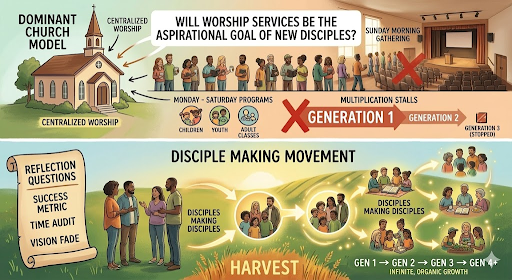
It’s the place where many of us found our faith, raised our kids, and built lifelong friendships. Whether you call it the “dominant,” “centralized,” or “classical” model, the typical Sunday-morning-gathering-plus-weekly-programs approach has been the heartbeat of spiritual life in the West for generations. It’s a good model, and it has served us well.
But here’s the rub: if that model starts to dream of a “Disciple- Making Movement” (DMM)—where disciples make disciples down to the third and fourth generations—it eventually hits a wall. And that wall isn’t just a minor hurdle; it’s a fundamental challenge to how we think about “doing church.”
The Reality of the “Slow” Harvest
I was catching up last week with a leader who has been waist-deep in the harvest since 2012. He’s spent over a decade deconstructing and reconstructing what it actually looks like to plant churches that multiply. It’s gritty work. It’s slow—at least for the first ten years.
He told me about a season where he and a teammate helped launch 30 churches in a single year. But when the dust settled? Only four groups remained, and only three of those self-identified as “churches.” He was honest about the internal toll that takes: the self-doubt, the seasons of fruitlessness, and the subtle (or not-so-subtle) pressure from friends and family to just go back to the “normal” way of doing things.
The Make-or-Break Question
I asked him point-blank: “What is the single greatest challenge for an existing church trying to adopt a movement approach?”
His answer was as simple as it was provocative. It all comes down to permission.
Are leaders willing to let disciple-making groups stay in the harvest? Are they okay with new disciples never attending a traditional Sunday worship service?
He’s observed a consistent pattern: if a church—consciously or unconsciously—expects new disciples to eventually “show up to the campus” for a service, the reproduction stalls. It rarely makes it past the second generation.
Why the Momentum Stalls
When a worship service becomes the ultimate “aspirational goal” for a new believer, the movement naturally begins to plateau. Here are three reasons why:
- A Shift in Focus: New disciples stop looking outward at the harvest and start looking inward at the stage. They move from being “active players” to “engaged spectators.”
- The Margin Squeeze: Between Sunday services, mid-week programs, and volunteer rotations, new believers find they have less and less time to actually sit with their unchurched neighbors.
- Comfort Over Commission: Once a new disciple’s needs are being met by the church’s excellent programming, the urgency to reach others often fades. The “vision” is replaced by “satisfaction.”
It’s a sobering thought for those of us who love the local church: Is our current definition of “success” actually the very thing standing in the way of a movement?
That’s a brave step. Identifying these blockages is one thing, but sitting with the discomfort of how they challenge our current leadership habits is where the real growth happens.
To help you and your team lean into this, here are five reflection questions designed to bridge the gap between the “Dominant Model” and a “Disciple-Making Movement.”
Reflection Questions for Leaders
- The “Success” Metric: If a group of ten new disciples met in a home for two years, multiplied into two more groups, and never once stepped foot on your campus, would you consider that a win for your church? Why or why not?
- The Time Audit: Look at the calendar of your most “committed” members. How much of their time is spent inside church-sponsored activities versus in the harvest with people who don’t know Jesus? Does our current programming create or consume margin?
- The Aspirational Goal: When we share testimonies or “success stories” from the stage, are we celebrating people who have joined a ministry team, or people who have started a discovery group in their workplace? What does that tell our congregation about what “mature” discipleship looks like?
- The “Attachment” Factor: Is our system designed to attach people to a Person (Jesus), a People (the harvest/community), or a Place (the building)? Which of those three is the easiest to replicate to the fourth generation?
- The Permission Gap: What specific “rules” or “expectations” (unspoken or otherwise) would we have to waive to allow a movement to stay in the harvest? Are we willing to let go of the need to “count” them in our Sunday attendance?
A Final Thought
The goal isn’t to tear down the “Sunday Celebration”—there is beauty and power in the gathering of the saints. The goal is to ensure the gathering serves the movement, rather than the movement serving the gathering.
Fuel for the Movement
Dive deeper into the shift from ministry models to multiplying movements.
Featured Resource: 7 Practices of Disciple Making Churches: New Research on What Works in North America. This book is worth reading if you are interested in how disciple-making movements are happening in North America. Bobby Harrington and Josh Howard have identified seven common practices from a handful of churches in the North American context that are actually multiplying disciples into the third, fourth, and fifth generations.
Multiplication Evaluation
Are you curious about multiplication? I received permission to synthesize this list from “Becoming a Level 5IVE Multiplying Church Field Guide” by Todd Wilson, Dave Ferguson, with Alan Hirsch. In addition, I created a simple evaluation for your use that is available here.
