

Reflecting on my recent involvement with a micro-church, or house church, network, and comparing it to the prevalent church model in the West, I recognize how different these two models are when examined through the framework of ATTRACTIONAL and MISSIONAL/INCARNATIONAL terminology (micro-church or house church).
The Great Divorce: Why We Struggle to Blend
Many leaders attempt to “bolt-on” missional living as an additional program. This approach often fails because the “operating system” of an attractional church is designed for gathering, whereas the missional life is oriented towards scattering. A congregation can certainly lean towards the other model, but the idea of being fully attractional AND missional presents a significant challenge.
- The Attractional Model serves as a “Cathedral”—a stunning environment for seekers to experience the sacred.
- The Missional Model functions as a “Network”—a decentralized movement of disciples engaging in the marketplace, gathering in homes, or in third spaces.
When you attempt to integrate both within the same structure, your staff may experience burnout, and your congregation may become perplexed. Whether you find yourself in the chaotic middle of a church plant or at the helm of an established congregation, the pressure to select a “side” is unyielding. Should you prioritize the Sunday experience—the lights, the band, and the clear message that attracts people? Or should you concentrate on the community—the gradual, incarnational effort of living among the people?
Here is a perspective on how the two models can complement one another. I do not aim to assert that one method is better than the other—merely that they are different! However, in this context, different is beneficial, as both approaches are necessary.
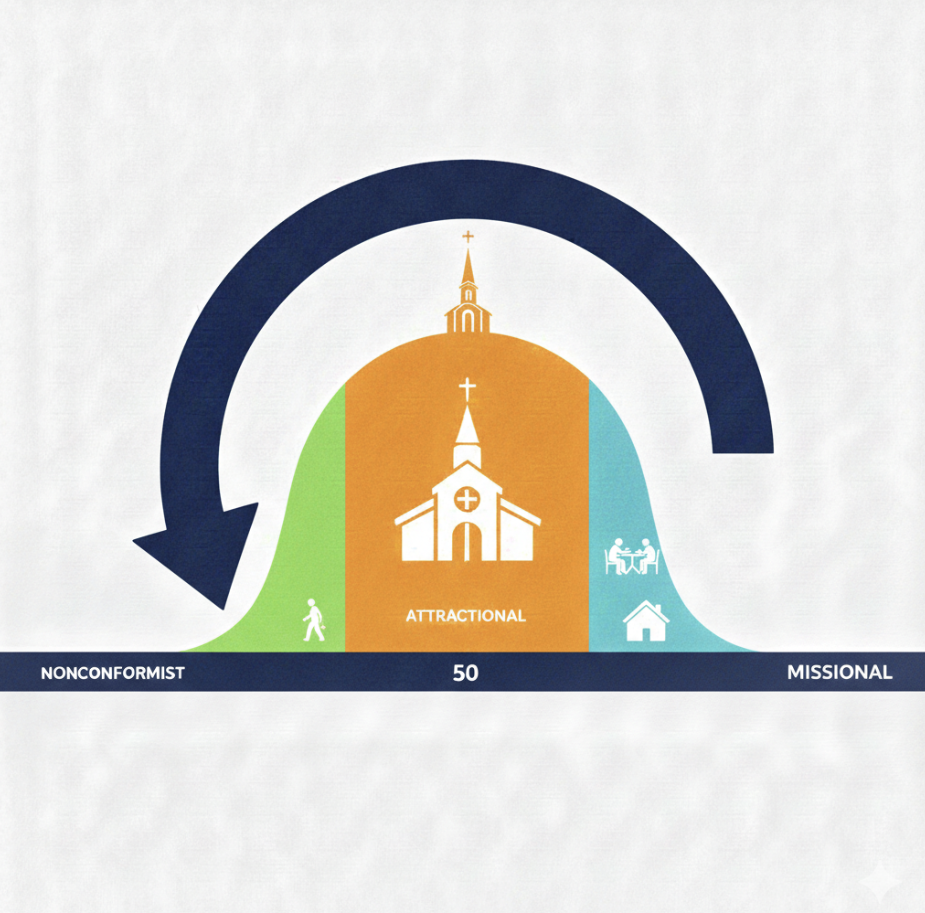
Attractional – Come & see what Jesus is doing
The Attractional model represents how most churches operate in the Western world: Sunday morning worship is designed to draw in those distant from God while nurturing the faith of believers. Corporate activities are focused on the church campus. Small groups, age-specific programs, and the mobilization of individuals based on their spiritual gifts and interests help integrate people into the church community. Below, this is illustrated in the orange zone.
Nonconformist – Unable to find a space that fits them
On the left side in the green zone lies the Nonconformist group. These individuals typically do not connect with what occurs during the corporate attractional gatherings in many churches. Why is this the case? There are numerous reasons. I recall inviting my friend Santos to my church during college. It was a classic example of what I refer to as the attractional church. He wasn’t particularly impressed. He didn’t dislike it; he simply didn’t connect with it. I can think of more extreme examples, but the reality is that Nonconformists do not see people like themselves represented, and I’m not primarily referring to race or ethnicity, which leads them to feel that their needs are not prioritized within the gathered community.
Missional – Community for the sake of others
On the right side of the bell curve are those I describe as individuals on a mission together for the benefit of others. The shared mission and incarnational approach drive this group to transition from the attractional church to newer forms such as micro-churches. The arrow signifies the dynamic flow of the mission.
If multiplication is your vision, then take this into account!
Micro-Church Networks are flexible.
- I witnessed this a few months back at the house church I attended. A couple in the community had a tree fall in their backyard due to heavy rainfall. That morning, the church shifted from its usual location to assist the family in clearing the debris and then held the church gathering in their home. The smaller size (micro-environments) around which the community is structured influences the mission.
Micro-Church Networks possess an impressive ability to replicate.
- This conclusion comes from a survey conducted by Exponential on micro-churches in 2025. While it may seem intuitive, the data now backs up the theory. You can download the report for free – CLICK HERE.
Micro-Church Networks engage more individuals with the five-fold gifts.
- From my experience, I can observe how individuals with the gifts of apostle, prophet, evangelist, shepherd, and teacher are activated in a micro-church. Smaller settings enable people to exercise their gifts in a secure environment. Larger gatherings are always an option, but typically, the norm is 3-20 people, gathered in a circle, discerning the work of the Spirit through scriptures, worship, prayer, and fellowship.
Micro-Church Networks are attractive communities for Nonconformists.
- During the holiday, I invited my two adult children to join the house church I have been attending to gather their feedback. I was taken aback. They described their church experience that morning as “compelling” due to the interaction, the opportunity to discuss differing perspectives, and authentic engagement.
Micro-Church Networks allocate a significant portion of their budget to financial investments.
- Beyond the essential needs to operate the network, funds are reinvested directly into the community the church serves. Larger networks necessitate oversight, care, and support. These are crucial as the number of churches expands into the third, fourth, fifth generation – and beyond.
There is much more that could be discussed regarding this subject, but from my recent experiences, I have noted the following. Globally, some of the most effective movements in disciple-making and church planting include elements of the micro-church DNA: love God, love your neighbor, and make disciples.
Questions for Your Personal Reflection:
- Do you think it is feasible to be both attractional AND missional? Why or why not?
- What approach are you most dedicated to?
- If money were not an issue, which option would you choose?
- What is your reasoning behind your answer to question #2?
- What feelings does the statement evoke in you: “…the idea of being fully attractional AND missional is difficult.”
