
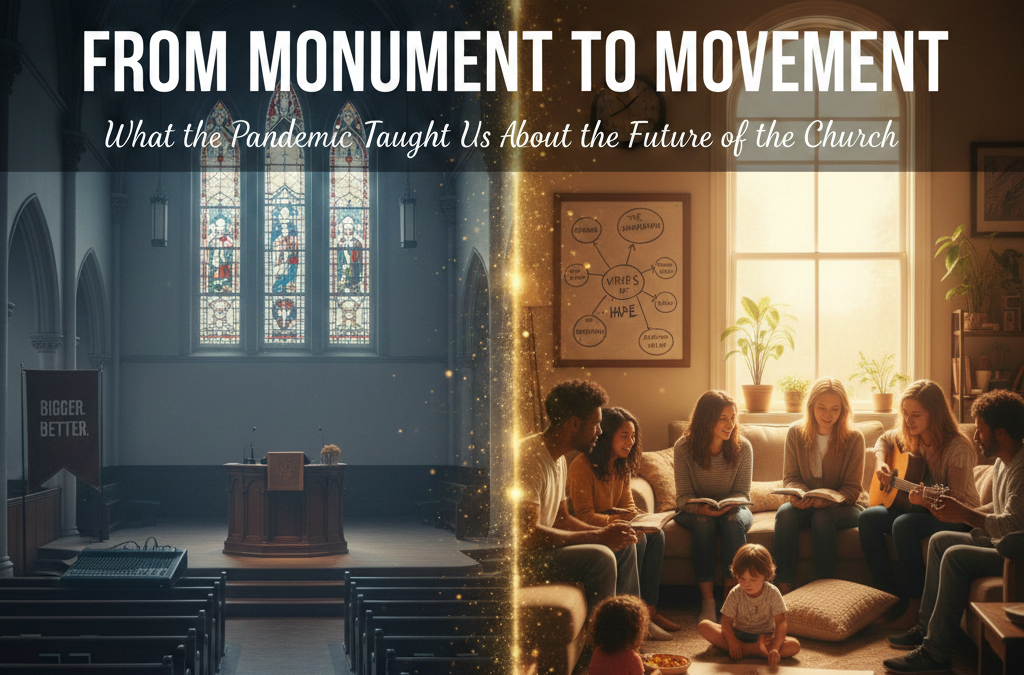
From Monument to Movement: What the Pandemic Taught Us About the Future of the Church
For decades, we were taught that the health of our ministry could be measured by the crowd in the pews and the hum of the HVAC system. Then, almost overnight, the doors were locked, and the chairs were empty.
Many of us spent the pandemic trying to figure out how to get the “program” online, waiting for the day we could “get back to normal.” But what if the disruption wasn’t a detour? What if the empty buildings were actually an invitation? In Viral: Hearing God’s Voice in a Global Pandemic…and Beyond, Neil Cole suggests that the crisis didn’t break the church—it unmasked it. It showed us that while we were busy building monuments to addition, God has always been interested in the power of viral multiplication.
Here are five key shifts every leader must consider as we lead “beyond” the crisis.
1. The “Apocalypse” as Revelation
The Greek word apokalypsis does not mean “the end of the world,” but rather “the unveiling.” The global pandemic functioned as a giant magnifying glass, exposing the structural cracks in our modern ecclesiology. For many congregations, when the Sunday gathering was stripped away, they realized there was very little “church” left in the remaining six days of the week.
- The Unveiling: It revealed our over-dependence on the “holy man, holy building, holy hour” model.
- The Leadership Pivot: Leaders must resist the urge to simply “return to normal.” Instead, we must ask: “What did the pandemic reveal about our discipleship that we can no longer ignore?” True leadership in a post-pandemic world is about building structures that are “antifragile”—systems that actually grow stronger under stress.
2. Hearing the “Still, Small Voice” Amidst Global Noise
In a world saturated with digital opinions, political polarization, and health anxieties, the ability of a leader to hear God is the ultimate currency. Cole suggests that the pandemic was a “global interruption” intended to break our addiction to busyness and noise.
- The Disciplined Ear: Discernment is not about predicting the future; it is about being present with the Father. The pandemic forced a collective “Sabbath” upon the world, reminding us that the mission of God does not depend on our frantic activity.
- The Leadership Pivot: Pastors must move from being “Content Creators” to “Spiritual Directors.” We must teach our people how to tune their ears to the frequency of the Holy Spirit so they can navigate the “Beyond” with peace rather than panic.
3. Decentralizing the Divine Encounter
For decades, we have conditioned believers to come to a central location to “experience” God. The pandemic broke that monopoly. When the doors were locked, God’s voice began to be heard in kitchens, on Zoom calls, and during neighborhood walks.
- Democratizing the Spirit: This is a return to the “Priesthood of all Believers.” If God can speak to a family in their living room without a professional liturgist present, the role of the pastor changes fundamentally.
- The Leadership Pivot: Denominational leaders should shift from managing “Central Hubs” to supporting “Distributed Networks.” We must empower the laity to believe that they are fully capable of hosting the presence of God without a middleman.
4. The Shift from “What” to “Who”
When crisis hits, the human brain demands to know what is happening and why. However, the viral nature of the Gospel is rooted in the Who.
- The Character of God: Instead of trying to provide theological justifications for suffering, the pandemic called the church to demonstrate the character of Jesus—the One who sits with the broken.
- The Leadership Pivot: Our preaching should shift from “Information” (explaining the crisis) to “Incarnation” (becoming the hands and feet of Christ). Leaders must help their people find their identity in whose they are, rather than what they do for the church institution.
5. Viral Hope: Reproducing the Gospel Organically
A virus is dangerous because it is small, invisible, and highly reproductive. Cole argues that the Gospel should be the same. The “Beyond” refers to a future where the church is not a destination but a movement that spreads through natural social fibers.
- Micro-Multiplication: The future belongs to small, agile “micro-churches.” These units are small enough to be intimate, yet potent enough to transform a neighborhood. They are “viral” because they don’t require a massive budget—they only require the presence of Jesus.
- The Leadership Pivot: Success is no longer measured by “How many people did we bring in?” but by “How many points of light did we send out?”
The Shift in Perspective
| Feature | Traditional Approach (Pre-Pandemic) | Viral Approach (Post-Pandemic) |
| Primary Location | The Sanctuary / Building | The Home / Social Network |
| Communication | Top-down (The Pulpit) | Multidirectional (The Body) |
| Success Metric | Attendance / Seating | Sending / Hearing & Obeying |
| Leadership Style | CEO / Performer | Coach / Spiritual Director |
| Core Strategy | Attractional Programs | Organic Multiplication |
Taking the First Step Toward Viral Health
Shifting from an institutional mindset to a viral one doesn’t happen by changing your Sunday bulletin; it happens by changing your soul’s scorecard. This week, I challenge you to take one “decentralizing” step:
- Identify a “Person of Peace”: Instead of planning a new program to bring people to you, ask God to show you one person in your community who is already open to the Gospel.
- Empower a Micro-Leader: Identify a layperson and, instead of giving them a task to do for the church, give them the “permission” to start a small discovery group in their own home or workplace.
The virus of the Gospel doesn’t need a stage to spread—it just needs a host. Are you ready to release control and watch the movement grow?
Join the Conversation
- Which of the five shifts feels most challenging for your current leadership context?
- How has your “scorecard” for success changed since the pandemic?
- What is one way your denomination or church can better empower “ordinary” believers to hear God’s voice?
