
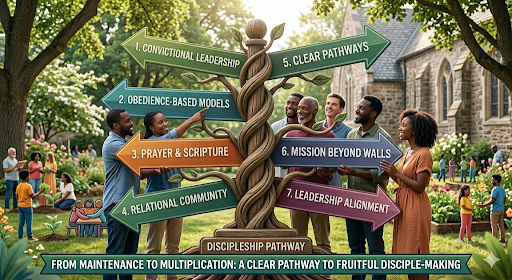
Is your church a “hospital” for the hurting, a “classroom” for the curious, or a “greenhouse” for growth? Most churches strive to be all three, but often get stuck in the cycle of program management.
If you’ve taken the Disciple-Making Assessment, you now have a snapshot of your church’s DNA. But a score is just a number until it becomes a conversation that leads to action. Whether your results were mostly “Green” (On Mission) or “Red” (Off Mission), here are practical ways to move the needle in each of the seven core areas.
1. Convictional Leadership
Prioritizing people over programs.
To move from managing an organization to leading a movement, leadership must shift its “success metrics.”
- The Tip: Audit your calendar. If your week is 90% meetings about logistics and 10% meetings with people you are personally discipling, flip the script.
- Action Step: Start every leadership meeting by sharing a story of a life being changed through a personal relationship, rather than reviewing the budget first.
2. Obedience-Based, Reproducible Models
Teaching “how to obey” rather than “how to know.”
Information alone doesn’t transform; application does. If your methods are too complex, they won’t be copied.
- The Tip: Use the “I Do, We Do, You Do” model. Don’t just give someone a book; show them how to study it, do it with them, and then watch them do it with someone else.
- Action Step: In your small groups, ask: “What is one specific thing you will do this week in response to this Scripture?” and follow up on it the next time you meet.
3. Prayer and Scripture as Foundations
Relying on the Spirit over the strategy.
Strategy is helpful, but the Holy Spirit is essential. If your plans don’t require God to show up for them to succeed, you might be dreaming too small.
- The Tip: Implement “Listening Prayer” in your leadership sessions. Instead of just praying for God to bless your plans, spend time in silence asking Him for His plans.
- Action Step: Ensure Scripture is the “primary voice” in the room. Before making a major decision, ask: “Does this align with the Great Commission, or are we just doing what’s comfortable?”
4. Relational Community
Intentionality over “hanging out.”
Fellowship is the “glue,” but discipleship is the “engine.” Healthy communities are safe enough for confession but intentional enough for challenge.
- The Tip: Foster a culture of “High Support, High Challenge.” Be the first to lead with vulnerability; when leaders share their struggles, it gives the congregation permission to be real.
- Action Step: Train your small group leaders to identify “Potential Leaders” within their groups from day one, rather than waiting for someone to “feel ready.”
5. Clear Pathways and Expectations
Clarity leads to movement.
If a newcomer has to guess how to grow in your church, they probably won’t. Complexity is the enemy of multiplication.
- The Tip: Simplify your “On-Ramp.” Can a 12-year-old explain how your church makes disciples? If not, your process might be too foggy.
- Action Step: Draw your discipleship pathway on a napkin. If it takes more than three steps (e.g., Connect, Grow, Multiply), trim the fat.
6. Mission Beyond the Walls
Success is measured by who we “send,” not who “sits.”
A church that only focuses on its Sunday service is a “cul-de-sac” for the Gospel. We want to be a “highway.”
- The Tip: Shift the focus to the Oikos (the 8 to 15 people with whom each member naturally interacts). Equip your people to see their workplace or neighborhood as their primary mission field.
- Action Step: Once a month, replace a standard “in-house” event with a “go-out” initiative where groups serve their local community together.
7. Leadership Alignment
Every department moving toward one goal.
If the youth ministry is doing one thing and the worship team is doing another, you’ll have a “silo” culture that drains energy.
- The Tip: Create a “Unified Win.” Every department head should be able to answer how their specific area contributes to making reproducing disciples.
- Action Step: Create a leadership pipeline. Identify people at the “Entry Level” (helpers), “Mid-Level” (leaders), and “Top Level” (coaches), and ensure everyone has a mentor.
“What is foggy in your head is confusing on a napkin. Clarity leads to movement.”
The goal of this assessment isn’t perfection—it’s reproduction. Pick one area today, gather your team, and decide on one “next step” you can realistically take this month.
How did your church score in the assessment, and which of these seven areas do you feel most compelled to focus on first?
Have you taken the Disciple-Making Assessment?
I recently picked up a book titled “7 Practices of Disciple Making Churches”. It is a fascinating read—one of the few I’ve found that digs into the traits of North American churches that are quietly adopting the powerful principles used by global disciple-making movements. Unlike the high-profile mega-churches that usually dominate our newsfeeds, these networks often fly under the radar, focusing more on depth than on the spotlight.
Are you ready to see where you stand? I’ve created an assessment to guide you and your team through the process to spark crucial conversations.
CLICK HERE to assess the Disciple-Making culture in your church!
Let’s move together from just managing crowds to truly multiplying the Kingdom. I’d love to hear what you discover as you walk through this with your team!