Transitioning from doing everything yourself to working with a Virtual Assistant (VA) is a huge milestone, but it’s also a big shift in mindset. It’s not just about offloading work; it’s about building a partnership that gives you your life back.
I made the transition, and encourage you to do the same. It is frustrating to see church leaders, denominational executives, and missionaries exhausted because they are attempting to do everything themselves. In the long run, you will do only what you can and enjoy your ministry more and more.
Here is a deeper look at how to navigate that journey with a relational, collaborative approach.
1. Brainstorm Everything You Can Delegate
Start by looking at your day through a “relational” lens—what tasks are draining your energy and keeping you from being present with your clients or your family? Grab a notebook and do a total brain dump. Don’t worry about whether a VA can do it yet; just focus on what takes you away from your “Zone of Genius.”
Admin: Inbox management, scheduling meetings, and data entry.
Personal: Booking travel, researching for a gift, or organizing your personal calendar.
Marketing: Posting to social media, formatting newsletters, or basic graphic design.
The “Paper Trail”: Invoicing, following up on late payments, or organizing digital files.
2. Prioritize the List
Now that you have your list, look at it with a focus on immediate relief. You don’t want to overwhelm your new partner on day one. Pick the “Low-Hanging Fruit”—tasks that are repetitive, easy to explain, and take up a lot of your time.
By prioritizing tasks that give you back 2–3 hours a week immediately, you’ll feel the value of the relationship right away. This builds the confidence you need to eventually hand over the bigger, more complex projects.
3. Work Through the List and Train as Needed
This is where the relationship is truly built. Think of training not as a chore, but as an investment in your VA’s success. If they thrive, you thrive.
Record yourself: Use a tool like Loom to record your screen while you do the task. Explain why you do it a certain way, not just the how.
Create a Playbook: Encourage your VA to document these processes into Standard Operating Procedures (SOPs).
Be Patient: Expect a learning curve. Your VA wants to do a great job for you, so give them the grace and the clear instructions they need to get there.
4. Introduce Essential Tools
To work effectively as a team, you need a “shared brain.” Using the right tools keeps everyone on the same page without you having to micromanage.
For Relationship Management: A tool likeLess Annoying CRM is perfect for this. It’s simple and collaborative, allowing your VA to update contact notes, track leads, and set follow-up reminders so no one falls through the cracks.
For Daily Action: UseTodoist to track progress. You can assign tasks to your VA, set due dates, and see when things are completed in real-time. It eliminates the “Did you get to that yet?” emails and keeps the energy focused on moving forward.
5. Communicate Regularly and Celebrate Often
The secret sauce to a long-term VA relationship is high-touch communication. Since you aren’t in the same office, you have to intentionally create “water cooler” moments.
The Weekly Sync: Spend 15–30 minutes on a video call once a week. Talk about what’s working, what’s confusing, and what’s coming up on the horizon.
Celebrate the Wins: When they catch a mistake you made or finish a project ahead of schedule, tell them! A simple “I couldn’t have done this launch without you” goes a long way.
Make it Personal: Ask about their life. When you treat your VA as a valued team member rather than just a “service,” they become personally invested in your business success.
Ready to stop “managing” and start leading?
Reading about delegation is the easy part; actually letting go is where the magic (and the growth) happens. To help you move from theory to action, I’ve put together a quick “Pulse Check.” Use these seven questions to audit your current workload and identify exactly where your Virtual Assistant can step in to buy back your time. Grab a coffee, be honest with yourself, and let’s find your missing five hours this week.
The Delegation Discovery: 7 Questions for a Better Partnership
The Energy Audit: Which recurring task on my plate consistently drains my creative energy or makes me procrastinate?
The Value Exchange: If I handed off five hours of administrative work this week, what high-level project or personal priority would I dedicate that time to?
The Bottleneck Check: Am I holding onto a task because I’m the only one who can do it, or simply because I haven’t taken the time to teach someone else how?
The Trust Factor: What is one small, low-risk task I can hand over today to begin building a “trust muscle” with my VA?
The Clarity Test: If I were to record a 2-minute video of this task, could a stranger complete it successfully, or is the process still living mostly in my head?
The Communication Gap: When was the last time I gave my VA specific feedback—not just on a mistake, but on something they are doing exceptionally well?
The Big Picture: One year from now, what does my ideal workday look like, and which responsibilities need to be fully offloaded to make that a reality?
Take 10 minutes this Friday to answer these. If you find yourself stuck on #5, it’s time to hit ‘Record’ on your next task! If you would like a worksheet with these questions – CLICK HERE:
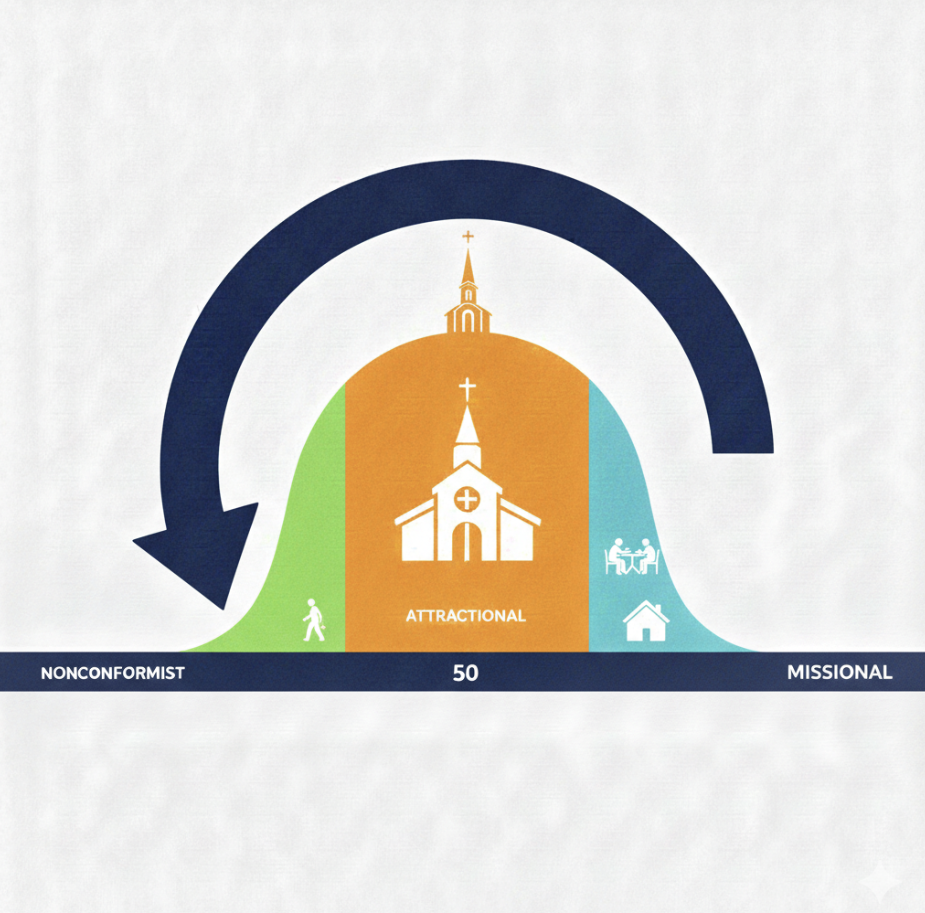
Reflecting on my recent involvement with a micro-church, or house church, network, and comparing it to the prevalent church model in the West, I recognize how different these two models are when examined through the framework of ATTRACTIONAL and MISSIONAL/INCARNATIONAL terminology (micro-church or house church).
The Great Divorce: Why We Struggle to Blend
Many leaders attempt to “bolt-on” missional living as an additional program. This approach often fails because the “operating system” of an attractional church is designed for gathering, whereas the missional life is oriented towards scattering. A congregation can certainly lean towards the other model, but the idea of being fully attractional AND missional presents a significant challenge.
The Attractional Model serves as a “Cathedral”—a stunning environment for seekers to experience the sacred.
The Missional Model functions as a “Network”—a decentralized movement of disciples engaging in the marketplace, gathering in homes, or in third spaces.
When you attempt to integrate both within the same structure, your staff may experience burnout, and your congregation may become perplexed. Whether you find yourself in the chaotic middle of a church plant or at the helm of an established congregation, the pressure to select a “side” is unyielding. Should you prioritize the Sunday experience—the lights, the band, and the clear message that attracts people? Or should you concentrate on the community—the gradual, incarnational effort of living among the people?
Here is a perspective on how the two models can complement one another. I do not aim to assert that one method is better than the other—merely that they are different! However, in this context, different is beneficial, as both approaches are necessary.
Attractional – Come & see what Jesus is doing
The Attractional model represents how most churches operate in the Western world: Sunday morning worship is designed to draw in those distant from God while nurturing the faith of believers. Corporate activities are focused on the church campus. Small groups, age-specific programs, and the mobilization of individuals based on their spiritual gifts and interests help integrate people into the church community. Below, this is illustrated in the orange zone.
Nonconformist – Unable to find a space that fits them
On the left side in the green zone lies the Nonconformist group. These individuals typically do not connect with what occurs during the corporate attractional gatherings in many churches. Why is this the case? There are numerous reasons. I recall inviting my friend Santos to my church during college. It was a classic example of what I refer to as the attractional church. He wasn’t particularly impressed. He didn’t dislike it; he simply didn’t connect with it. I can think of more extreme examples, but the reality is that Nonconformists do not see people like themselves represented, and I’m not primarily referring to race or ethnicity, which leads them to feel that their needs are not prioritized within the gathered community.
Missional – Community for the sake of others
On the right side of the bell curve are those I describe as individuals on a mission together for the benefit of others. The shared mission and incarnational approach drive this group to transition from the attractional church to newer forms such as micro-churches. The arrow signifies the dynamic flow of the mission.
If multiplication is your vision, then take this into account!
Micro-Church Networks are flexible.
I witnessed this a few months back at the house church I attended. A couple in the community had a tree fall in their backyard due to heavy rainfall. That morning, the church shifted from its usual location to assist the family in clearing the debris and then held the church gathering in their home. The smaller size (micro-environments) around which the community is structured influences the mission.
Micro-Church Networks possess an impressive ability to replicate.
This conclusion comes from a survey conducted by Exponential on micro-churches in 2025. While it may seem intuitive, the data now backs up the theory. You can download the report for free – CLICK HERE.
Micro-Church Networks engage more individuals with the five-fold gifts.
From my experience, I can observe how individuals with the gifts of apostle, prophet, evangelist, shepherd, and teacher are activated in a micro-church. Smaller settings enable people to exercise their gifts in a secure environment. Larger gatherings are always an option, but typically, the norm is 3-20 people, gathered in a circle, discerning the work of the Spirit through scriptures, worship, prayer, and fellowship.
Micro-Church Networks are attractive communities for Nonconformists.
During the holiday, I invited my two adult children to join the house church I have been attending to gather their feedback. I was taken aback. They described their church experience that morning as “compelling” due to the interaction, the opportunity to discuss differing perspectives, and authentic engagement.
Micro-Church Networks allocate a significant portion of their budget to financial investments.
Beyond the essential needs to operate the network, funds are reinvested directly into the community the church serves. Larger networks necessitate oversight, care, and support. These are crucial as the number of churches expands into the third, fourth, fifth generation – and beyond.
There is much more that could be discussed regarding this subject, but from my recent experiences, I have noted the following. Globally, some of the most effective movements in disciple-making and church planting include elements of the micro-church DNA: love God, love your neighbor, and make disciples.
Questions for Your Personal Reflection:
Do you think it is feasible to be both attractional AND missional? Why or why not?
What approach are you most dedicated to?
If money were not an issue, which option would you choose?
What is your reasoning behind your answer to question #2?
What feelings does the statement evoke in you: “…the idea of being fully attractional AND missional is difficult.”
From Monument to Movement: What the Pandemic Taught Us About the Future of the Church
For decades, we were taught that the health of our ministry could be measured by the crowd in the pews and the hum of the HVAC system. Then, almost overnight, the doors were locked, and the chairs were empty.
Many of us spent the pandemic trying to figure out how to get the “program” online, waiting for the day we could “get back to normal.” But what if the disruption wasn’t a detour? What if the empty buildings were actually an invitation? In Viral: Hearing God’s Voice in a Global Pandemic…and Beyond, Neil Cole suggests that the crisis didn’t break the church—it unmasked it. It showed us that while we were busy building monuments to addition, God has always been interested in the power of viral multiplication.
Here are five key shifts every leader must consider as we lead “beyond” the crisis.
1. The “Apocalypse” as Revelation
The Greek word apokalypsis does not mean “the end of the world,” but rather “the unveiling.” The global pandemic functioned as a giant magnifying glass, exposing the structural cracks in our modern ecclesiology. For many congregations, when the Sunday gathering was stripped away, they realized there was very little “church” left in the remaining six days of the week.
The Unveiling: It revealed our over-dependence on the “holy man, holy building, holy hour” model.
The Leadership Pivot: Leaders must resist the urge to simply “return to normal.” Instead, we must ask: “What did the pandemic reveal about our discipleship that we can no longer ignore?” True leadership in a post-pandemic world is about building structures that are “antifragile”—systems that actually grow stronger under stress.
2. Hearing the “Still, Small Voice” Amidst Global Noise
In a world saturated with digital opinions, political polarization, and health anxieties, the ability of a leader to hear God is the ultimate currency. Cole suggests that the pandemic was a “global interruption” intended to break our addiction to busyness and noise.
The Disciplined Ear: Discernment is not about predicting the future; it is about being present with the Father. The pandemic forced a collective “Sabbath” upon the world, reminding us that the mission of God does not depend on our frantic activity.
The Leadership Pivot: Pastors must move from being “Content Creators” to “Spiritual Directors.” We must teach our people how to tune their ears to the frequency of the Holy Spirit so they can navigate the “Beyond” with peace rather than panic.
3. Decentralizing the Divine Encounter
For decades, we have conditioned believers to come to a central location to “experience” God. The pandemic broke that monopoly. When the doors were locked, God’s voice began to be heard in kitchens, on Zoom calls, and during neighborhood walks.
Democratizing the Spirit: This is a return to the “Priesthood of all Believers.” If God can speak to a family in their living room without a professional liturgist present, the role of the pastor changes fundamentally.
The Leadership Pivot: Denominational leaders should shift from managing “Central Hubs” to supporting “Distributed Networks.” We must empower the laity to believe that they are fully capable of hosting the presence of God without a middleman.
4. The Shift from “What” to “Who”
When crisis hits, the human brain demands to know what is happening and why. However, the viral nature of the Gospel is rooted in the Who.
The Character of God: Instead of trying to provide theological justifications for suffering, the pandemic called the church to demonstrate the character of Jesus—the One who sits with the broken.
The Leadership Pivot: Our preaching should shift from “Information” (explaining the crisis) to “Incarnation” (becoming the hands and feet of Christ). Leaders must help their people find their identity in whose they are, rather than what they do for the church institution.
5. Viral Hope: Reproducing the Gospel Organically
A virus is dangerous because it is small, invisible, and highly reproductive. Cole argues that the Gospel should be the same. The “Beyond” refers to a future where the church is not a destination but a movement that spreads through natural social fibers.
Micro-Multiplication: The future belongs to small, agile “micro-churches.” These units are small enough to be intimate, yet potent enough to transform a neighborhood. They are “viral” because they don’t require a massive budget—they only require the presence of Jesus.
The Leadership Pivot: Success is no longer measured by “How many people did we bring in?” but by “How many points of light did we send out?”
The Shift in Perspective
Feature
Traditional Approach (Pre-Pandemic)
Viral Approach (Post-Pandemic)
Primary Location
The Sanctuary / Building
The Home / Social Network
Communication
Top-down (The Pulpit)
Multidirectional (The Body)
Success Metric
Attendance / Seating
Sending / Hearing & Obeying
Leadership Style
CEO / Performer
Coach / Spiritual Director
Core Strategy
Attractional Programs
Organic Multiplication
Taking the First Step Toward Viral Health
Shifting from an institutional mindset to a viral one doesn’t happen by changing your Sunday bulletin; it happens by changing your soul’s scorecard. This week, I challenge you to take one “decentralizing” step:
Identify a “Person of Peace”: Instead of planning a new program to bring people to you, ask God to show you one person in your community who is already open to the Gospel.
Empower a Micro-Leader: Identify a layperson and, instead of giving them a task to do for the church, give them the “permission” to start a small discovery group in their own home or workplace.
The virus of the Gospel doesn’t need a stage to spread—it just needs a host. Are you ready to release control and watch the movement grow?
Join the Conversation
Which of the five shifts feels most challenging for your current leadership context?
How has your “scorecard” for success changed since the pandemic?
What is one way your denomination or church can better empower “ordinary” believers to hear God’s voice?
The Lobiko Initiative took my team to the Democratic Republic of Congo this past July to transition from our virtual leadership training into an intensive, in-person Christian coaching workshop. The mission focuses on “training the trainers” using a biblically grounded and culturally adapted framework to empower local leaders to equip future leaders for community transformation. Alongside the training, we toured the important work the Lobiko team is doing in Gemena, including a medical center, college, and an orphanage.
We learn from St. Ignatius that soul care is an essential, intentional practice for ministry leaders to combat the “fast-paced” cultural narrative. Leaders must actively nurture their spiritual well-being because an untended soul naturally slides toward negativity and burnout. To help leaders model what they believe, we have provided seven practical habits—ranging from nature and creativity to service and gratitude—encouraging you to take one specific action to live a truly vibrant life.
Lent is a spiritual reset, encouraging leaders to hit pause on life’s “busyness” to focus on deep devotion and growth as a disciple of Jesus. Starting with the mortality and penitence emphasized on Ash Wednesday, the journey combines practical action—like fasting or adopting new habits—with the ancient wisdom of St. Ignatius’s Spiritual Exercises. Readers are invited to engage in weekly reflections, Scripture readings, and the “Prayer of Examen” to cultivate interior suffering with Christ and build more meaningful spiritual rhythms. Ultimately, by intentionally slowing down and seeking “grace,” believers can foster a deeper love for Jesus and a more effective leadership style.
In this blog, we explore the Ignatian “grace” of sorrowing with Christ, arguing that intentionally sitting with Jesus’ suffering prevents us from over-focusing on His divinity at the expense of His relatable humanity. By slowing down during Lent rather than rushing to the celebration of Easter, believers can better appreciate the depth of Christ’s sacrifice and His permanent connection to our own human struggles. Ultimately, engaging with Christ’s anguish expands our capacity for empathy, helps us navigate personal overwhelm, and deepens our intimate relationship with a Savior who understands suffering firsthand.
There is a perceived void in the modern church by shifting the focus from simply telling people what God said to equipping them to hear and discern His voice for themselves. Drawing on the “APEST” framework and Ephesians 4, the prophetic leader is highlighted as a “disturber” who challenges the status quo and acts as a coach to help others develop their own spiritual discernment. This equipping function is essential for moving a congregation from a state of dependency on a single leader to a vibrant, multiplying community of mature disciples.
Reflecting on the Lausanne 4th Congress, the “business” of the Church is people transformation and Kingdom expansion through disciple-making movements. Tracking metrics like spiritual generations and leadership development is essential because we naturally prioritize what we measure, yet many leaders are distracted by finances, facilities, and ministry busyness. To keep the Great Commission as the primary focus, we recommend a relational five-step framework and a set of practical metrics to shift from an event-based ministry model to one of exponential spiritual multiplication.
The essential habits of a growing disciple are—Bible study, confession, making disciples, service, and fellowship. While these biblical principles are universal, their execution must be “contextualized” for the American culture, such as using relational spiritual formation language rather than direct calls for confession. By prioritizing creative and culturally sensitive expressions of these habits, leaders are encouraged to move beyond rigid methodologies toward authentic, life-giving transformation.
A successful church plant is often the result of a rigorous assessment process that identifies a leader’s unique strengths and growth areas before they launch. By combining behavioral interviews, which analyze past performance, with trait assessments like the Harrison Assessment, church planting movements can significantly increase a leader’s long-term sustainability and productivity. These tools serve as a “personal compass” for the planter, ensuring they not only build a thriving church but also maintain their personal health and family relationships. Ultimately, such data-driven investments are vital for good stewardship of the resources dedicated to eternal Kingdom work.
The ancient Ignatian Exercises serve as a practical and powerful framework for spiritual discernment in modern decision-making. While we must acknowledge potential hurdles like its military origins or Catholic roots, the structure and use of “sanctified imagination” help leaders engage both the mind and soul rather than relying on logic alone. By intentionally slowing down to sorrow with Christ, practitioners can experience benefits such as increased humility, curiosity, and a deeper ability to listen to the Holy Spirit.
The “Breakthrough Circle” framework can be used to navigate personal change and establish lasting spiritual habits. Using his own journey into spiritual formation as an example, the author explains how an inflection point of dissatisfaction and curiosity leads to a cycle of discovery (observation, reflection, discussion) and intentional action (planning and accountability). This tool is a versatile resource for leaders to use in their own lives, within their ministries to equip disciples, and even with family and friends to process significant life shifts. It’s time to move beyond mere desire for growth by adopting a structured, relational process that turns new insights into sustained realities.
This list is more than just a ranking—it’s a snapshot of our collective curiosity. We’d love to hear your insights:
Do you see a pattern? Is there a central theme running through the top 10 that reflects our focus this year?
What made them must-read material? Why do you think these posts were the ones everyone had to see?
Which one was your favorite? Tell us which post resonated with you personally.
Thank you, as always, for your prayers and continued support this year. Get ready; 2026 is going to be amazing!
As you step into 2026, may you walk with faith, courage, and confidence, knowing that God’s love accompanies you always. We don’t know what the future holds for us, but we know who is holding our future, and in that, we can take solace. We hope you will continue this journey with us into 2026, as we have many exciting things planned.
The Lord bless you and keep you; the Lord make his face shine upon you and be gracious to you; the Lord turn his face toward you and give you peace.” — Numbers 6:24-26 NIV
We use cookies to optimize our website and our service.
Functional
Always active
The technical storage or access is strictly necessary for the legitimate purpose of enabling the use of a specific service explicitly requested by the subscriber or user, or for the sole purpose of carrying out the transmission of a communication over an electronic communications network.
Preferences
The technical storage or access is necessary for the legitimate purpose of storing preferences that are not requested by the subscriber or user.
Statistics
The technical storage or access that is used exclusively for statistical purposes.The technical storage or access that is used exclusively for anonymous statistical purposes. Without a subpoena, voluntary compliance on the part of your Internet Service Provider, or additional records from a third party, information stored or retrieved for this purpose alone cannot usually be used to identify you.
Marketing
The technical storage or access is required to create user profiles to send advertising, or to track the user on a website or across several websites for similar marketing purposes.