Ever stumbled across a single comment in a podcast that made you completely pause and rethink a common workplace practice?
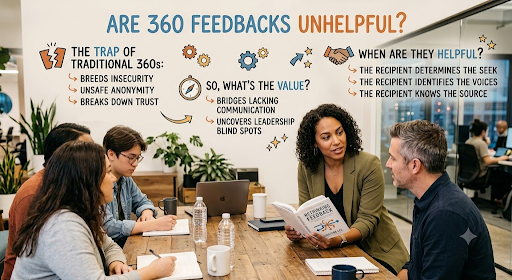
I was recently reading a book by a highly respected author who brought up 360-degree feedback assessments, and he dropped a surprising conclusion: 360 feedback is actually unhelpful to the person receiving it.
At first, that might sound counterintuitive. We’ve been taught that more feedback is always better, right? But as he broke it down, the reasoning really resonated.
Why Traditional 360s Fall Short
When you look under the hood, traditional 360-degree reviews often backfire for three main reasons:
They breed insecurity: Instead of inspiring growth, getting a massive dump of critique often leaves people feeling defensive, overwhelmed, and second-guessing themselves.
Anonymity makes them feel unsafe: When feedback is anonymous, it loses its context. It leaves the recipient trying to guess who said what, turning a growth exercise into a psychological mystery game.
They break down trust: Rather than bringing a team closer together, secret critiques can create paranoia and weaken the authentic bonds between colleagues.
Do 360s Have Any Value?
That’s not to say 360s are completely useless. They do serve a purpose in specific scenarios:
Filling a cultural gap: If a team lacks a healthy, everyday culture of open communication, a formal 360 can serve as a temporary bridge to get people talking.
Uncovering blind spots: For leaders who truly have no idea how their behavior impacts others, the raw data can be a necessary wake-up call.
Flipping the Script: How to Make 360s Work
So, how do we fix this? I had a conversation with a leader of a mission agency recently and discussed how 360 assessments can actually be transformative, but only when we hand the steering wheel back to the team member.
Feedback becomes genuinely helpful when:
1. The recipient drives the focus:They decide what specific areas they want feedback on.
2. The recipient chooses the voices:They select the colleagues whose perspectives they value and trust.
3. Transparency replaces anonymity:They know exactly who gave what feedback, creating a safe space for real, constructive follow-up conversations.
When we shift from evaluating people in secret to empowering them to ask for the insights they need, feedback stops being a source of anxiety and becomes the powerful tool for growth it was always meant to be.
Every once in a while, you cross paths with someone who truly stands out—someone who pairs exceptional character with a deep curiosity, vibrant faith, and remarkable talent. For me, that person is Wilita Sanguma.
Above all else, the trait I admire most in Wilita is his genuine, God-given humility. There is something about a humble heart that beautifully draws people closer to Jesus, and Wilita treats everyone he meets exactly how I imagine Jesus did when He walked the earth. Wilita’s journey is incredible; God deeply shaped him through his early years in the Democratic Republic of Congo (DRC), where he escaped violence in his home village before eventually immigrating to the United States. To learn more about Wilita’s journey CLICK HERE.
If you are as inspired by his journey as I am, I’d love to connect with you. If you want to hear more of his story or are interested in having him speak at an event, please drop us a line at admin@infocusnet.org.
Moving the Mission Forward: Disciple-Making & Coaching in Congo
About two years ago, Wilita and I began dreaming about what it would look like to train leaders in Congo in Christian coaching. (You can read more about those early conversationsHERE.) He leads an organization called Lobiko that partners with committed individuals who drive efforts to transform the lives of vulnerable children, youth, and adults living in extreme poverty. Since then, God has been moving.
From the in-person workshop in Kinshasa, DCR – July 2025
Left to right: David, Joel, Lischa, Wilita, and Gary
This past March, Wilita and his colleague in DRC, Lischa, hosted an introductory workshop to introduce leaders in Gemena to the power of Christian coaching. Because coaching is a relatively new concept in that part of the world, this was a brand-new experience for them—and the response was overwhelmingly enthusiastic! The leaders left with a deep eagerness to learn more.
From that initial group, they have selected about 20 participants to dive deeper into a second workshop scheduled for this fall. As we prepare, our team is actively discussing how to integrate a simple, natural disciple-making approach directly into the coach training process.
Why Pair Disciple-Making with Coaching?
It’s a question I hear often: Why blend disciple-making into coach training?
To put it simply, they go hand in hand. When you look at how Jesus lived and interacted with the world, He always respected the individual. He gave people the dignity of choice, never imposing His will or forcing his way upon those He invited into a life of apprenticeship. Instead, He guided them toward self-discovery.
Three vital dynamics drive this journey of self-discovery:
The Prompting of the Holy Spirit: When the Holy Spirit highlights a new idea, behavior, or action in someone’s heart, it becomes almost impossible to ignore. Learning to listen to that voice is the heartbeat of both disciple making and Christian coaching. You can think of coaching as the relational side of the equation and disciple-making as the strategic side—with the Holy Spirit serving as the perfect bridge between them.
Trustworthy Relationships: While the Holy Spirit often reveals Himself directly through dreams, visions, or miracles, walking out that faith requires community. Having a trustworthy relationship with another believer or a small group helps a new disciple process what they are experiencing and take healthy steps forward. Information is valuable, but relationships coupled with inspiration from the Holy Spirit and Scripture accelerates true spiritual growth.
Active Listening and Meaningful Questions: While disciples can grow entirely on their own, that tends to be the exception rather than the rule. Whether you use the formal word “coaching” or not, having a conversational framework centered on active listening and asking thoughtful questions is a game-changer. It helps new disciples discern the Spirit’s voice, identify practical steps of obedience, and ultimately fosters a culture of reproduction and multiplication.
A Heavy Reality on the Ground in Congo
As we celebrate these steps forward, our hearts are also heavy for the people of Congo. The country is currently facing an outbreak of the Bundibugyo Ebola virus. This particular strain has a historic mortality rate between 30% and 50%, and because there is no existing vaccine for it, containment relies entirely on traditional, difficult public health measures like strict isolation and intense contact tracing.
While the rest of the world watches from a distance, our brothers and sisters in Congo—who already navigate the challenges of severe poverty—are facing a very real, frightening enemy.
How You Can Stand With Us
Meet Wilita: Listen to Wilita’s story and see if the Lord might be prompting you to invite him to speak at an event in the future CLICK HERE.
Pray Continuously: Please lift up Wilita, Lischa, and the entire Lobiko team as they navigate leadership and ministry during this challenging season.
Connect and Support: Reach out to us at admin@infocusnet.org to discover how you can support this important work in Congo or connect directly with Wilita.
I was asked to discuss the importance of disciple makers being trained to use a coach approach. For context, the lead pastor leads a large congregation, all staff are engaged in disciple-making, and some of their leaders are experiencing real success. The pastor wanted to be convinced that it was absolutely necessary that disciple makers needed to be trained in coaching to multiply disciples.
Clarifying the Problem:
Recognizing there is a problem is the first step. If you are happy with the fruit you are experiencing then maybe, just maybe, coaching is not necessary. But if you are like most leaders who are brave enough to conduct a disciple-making audit, there is always room for improvement.
Problem #1: Growing in knowledge will make disciples.
Problem #2: Short-cuts in the short-term compromises multiplication in the long-term.
Problem #3: Relying on resources for work that only the Holy Spirit can accomplish.
Problem #4: Underestimating the power of a relationship – with a purpose.
Problem #5: Lack of humility.
Breaking the Addition Bottleneck
Every leader driving a Disciple Making Movement (DMM) reaches a critical, unspoken tipping point. The early momentum is exhilarating: groups are forming, Discovery Bible Studies (DBS) are active, and the initial wave of new believers is growing. But as the movement pushes past the second generation and approaches the third, fourth, and fifth generations, a subtle and dangerous friction sets in.
The bottleneck is rarely a lack of apostolic vision or a flaw in the theological framework. The bottleneck is the infrastructure of leadership development.
Many movement leaders view formal coach training as an unnecessary, corporate distraction from the raw work of the Great Commission. However, global data proves otherwise. Without an intentional, reproducible “coach approach”—built on active listening, powerful questions, and non-directive empowerment—the weight of managing a movement collapses back into a centralized, addition-based model. Coaching is not an administrative add-on; it is the structural support that allows a movement to scale organically and remain anchored directly to Jesus.
“If you are the only one who can lead your small group, give the sermon, or run the ministry, you aren’t leading a movement—you are managing a bottleneck.”
— Dr. Adam Grill, The Secret Sauce of Church Multiplication
Why Movements Stall at Gen 2
When a large, dynamic church champions a disciple-making movement, its natural institutional strength can accidentally become its greatest liability. Leaders are accustomed to instructing, directing, and providing answers.
When applied to a multiplying movement, this directive style creates high dependencies. New disciples rely on the church planters; church planters rely on the network leaders; and the network leaders rely on the senior pastor.
True multiplication requires an unconditional handoff of spiritual authority. If your training strategy relies purely on content delivery, you will hit a ceiling at the second generation. To break into 3rd, 4th, and 5th-generation multiplication, leaders must shift from doing for the movement to coaching the movement.
Global Evidence: The Power of a Coach Approach
To see the impact of integrating a coach approach into rapid disciple-making, consider three distinct global contexts:
1. Collapsing the Timeline: From 14 Years to Rapid Multiplication
A prominent global mission agency operating in highly restricted regions wrestled with a systemic problem: it took an average of 14 years to plant a single church using traditional, directive methods. The agency realized that pouring more content into their workers wasn’t working.
To fix this, they initiated a five-day training framework across five global regions (including India, Turkey, and Spain). They paired Disciple Making Movements in the morning with structured Coach Training in the afternoon.
The results were paradigm-shifting. Every single mission group interviewed stated that teaching coaching principles in direct coordination with DMM was the missing element. Living in the tension of technical DMM strategy and relational coaching allowed them to plant churches with reproducing coaching DNA right from day one. They collapsed traditional timelines by equipping missionaries to step out of the “expert” seat and step into the coach’s seat.
2. Supporting the Frontlines: Scaling Leadership for 15,000 Planters in India
In India, a rapidly expanding church planting movement faced a catastrophic deficit in frontline care. Thousands of new planters were out in the field with minimal personal support, leading to high burnout and stagnant growth past the initial launch phase.
The movement did not solve this by creating more curriculum. Instead, they strategically trained a dedicated team of church planting supervisors to operate as coaches.
By equipping these supervisors with formal coaching competencies, they created a relational infrastructure capable of supporting 15,000 church planters. These planters weren’t being managed by a distant hierarchy; they were being actively coached by local leaders who knew how to listen, troubleshoot, and empower. This coaching layer transformed a chaotic network into a sustainable, multiplying movement.
3. The Power of Simplicity: Attaching Disciples Directly to Jesus
Movement pioneers like Neil Cole have long demonstrated that the simplest approaches to disciple-making are the most explosive. When disciple-making is kept simple, the newest disciples are forced to rely directly on Jesus through the Holy Spirit and the Word, rather than relying on human experts.
This is where coaching becomes an essential spiritual discipline. A coach approach replaces lecturing with active listening and powerful, open-ended questioning.
Instead of giving a new believer the answer, a coach asks: “What is the Holy Spirit saying to you through this text, and how are you going to obey it this week?” This simple shift ensures that the umbilical cord of the newest disciple remains firmly attached to Jesus, the head of the Church, rather than to a human mentor or a local church staff member.
Transferable Principles for Movement Leaders
Integrating a coach approach into your disciple-making movement yields a clear set of transferable principles that accelerate multiplication:
The Principle of Synergy: Pair the technical mechanics of disciple-making (like Discovery Bible Studies) with the relational skills of coaching. Content tells people what to engage; coaching helps them process how to live it out.
The Principle of Non-Directive Empowerment: Shift from giving answers to asking powerful questions. This shifts the ownership of growth from the teacher to the learner, making the model instantly reproducible.
The Principle of Structural Tension: Allow emerging leaders to sit in the healthy tension of making disciples and figuring out how to develop the next generation of leaders. Coaching provides the relational safety net to navigate this stretch.
The Principle of Distributed Oversight: To scale a movement across thousands of groups, you cannot scale management; you can only scale coaching. Coaching decentralizes care while maintaining high relational accountability.
The Strategic Invitation
If you want to see your church’s movement reach the 4th and 5th generations, the next step is not writing a better curriculum or hosting a larger conference. The next step is building a sustainable, reproducible coaching culture that empowers the everyday believer to lead.
Investing in coach training is the strategic bridge that transforms an addition-based mega-church into an exponential, unstoppable kingdom movement.
Reflection Questions:
How many disciple makers do you have?
How many generations deep are your highest producers?
How satisfied are you with their progress?
Where do you expect them to be in 12-18 months time?
How will your top producers navigate the shift from being the disciple maker to coaching disciple makers?
We use cookies to optimize our website and our service.
Functional
Always active
The technical storage or access is strictly necessary for the legitimate purpose of enabling the use of a specific service explicitly requested by the subscriber or user, or for the sole purpose of carrying out the transmission of a communication over an electronic communications network.
Preferences
The technical storage or access is necessary for the legitimate purpose of storing preferences that are not requested by the subscriber or user.
Statistics
The technical storage or access that is used exclusively for statistical purposes.The technical storage or access that is used exclusively for anonymous statistical purposes. Without a subpoena, voluntary compliance on the part of your Internet Service Provider, or additional records from a third party, information stored or retrieved for this purpose alone cannot usually be used to identify you.
Marketing
The technical storage or access is required to create user profiles to send advertising, or to track the user on a website or across several websites for similar marketing purposes.