When you sit back and watch how people navigate their disciple-making journeys, one thing becomes crystal clear: there isn’t a one-size-fits-all path. Each person’s story is unique, marked by distinct turning points that propel them forward. While simple, reproducible cycles can help map out the process, we run into trouble when we try to rush it.
So, how long does it actually take for someone to move from their first introduction to the Gospel to baptism?
Honestly, it depends entirely on the context. Sometimes it happens almost instantly; other times, it takes decades.
I recently tried to intentionally build a relationship with a new friend, and I quickly realized how easy it is to make assumptions and get things wrong. After a few failed attempts to get together, we finally went on a hike. It was so much fun just discovering what he cared about—no pressure, no agenda other than getting to know one another. The entire time was spent simply connecting. It was a good reminder that trust building takes time.
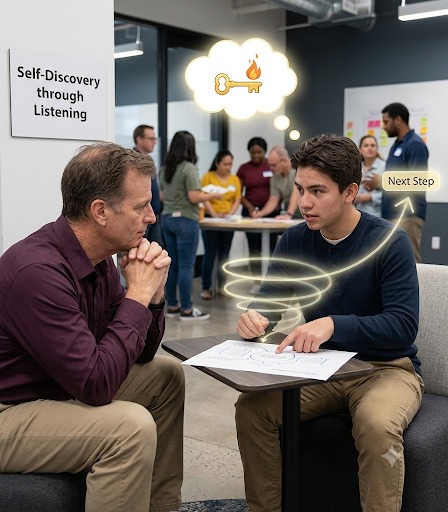
I was reminded that the gap between initial awareness of God and becoming a devoted follower of Christ can be bridged by a guide—a person or community who listens intently, offers a safe place to process, and supports the journey.
Three Things a Guide Does to Support a New Disciple
Connect: Build authentic, agenda-free trust with the person right where they are.
Assess: Pay close attention to understand where they currently sit on their spiritual journey.
Identify: Help them discover a practical, personal next step to move forward.
If you are walking alongside someone exploring faith—or want to sharpen your ability to connect—try this simple practice next time you grab coffee or head out on a walk:
1. Ask: “What are you most excited about today?” Then, truly listen.
2. Ask: “What do you love doing in your free time?” Listen again.
3. Reflect on their responses and note what you learned about them that you didn’t know before.
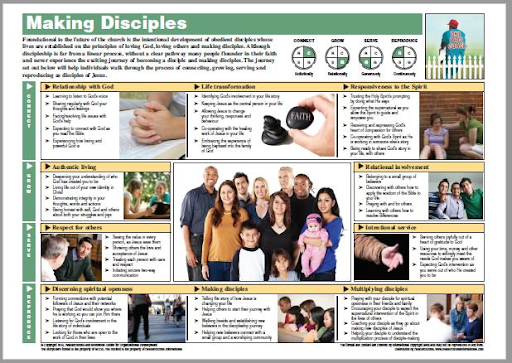
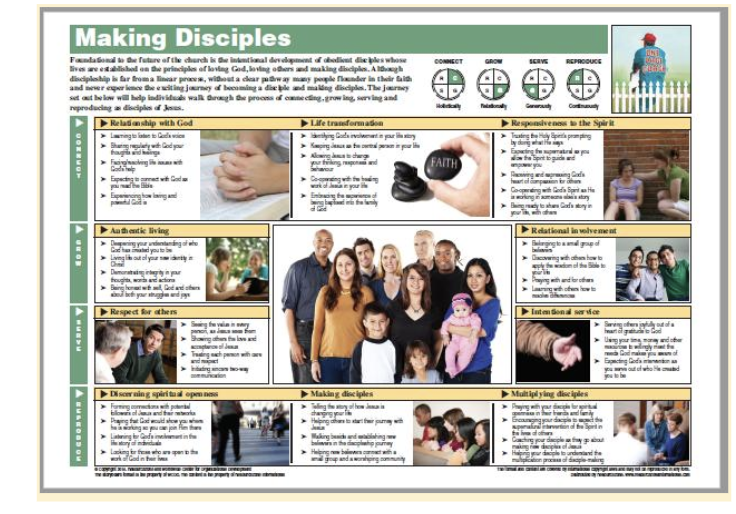
Below is a guide that can help you learn about the disciple-making process, consider questions that can be asked of the disciple to help open up the conversation, and identify where they are on their journey. Click on the image below!
Want to take a closer look at the Making Disciples Storyboard?
Ever had one of those moments where someone asks you a simple question, and your brain decides to answer with everything including the kitchen sink?
That happened to me recently in a workshop. A participant raised their hand and asked a straightforward question: How do you define coaching for disciple-making?
Instead of giving a crisp response, I launched into a convoluted explanation that felt more like a sprawling lecture than a helpful answer. As soon as the words left my mouth, I knew I needed to step back and reflect.
How could I make this succinct, clear, and actually compelling?
To get there, I realized I had to start with the foundational question: What is a disciple?
Back in seminary, I had the privilege of observing Bill Bright up close. His heart and passion sparked a fire in me—a commitment to spend my life understanding discipleship. Forty years later, I’m still on that quest.
If I had to boil four decades of learning down to its simplest form, it’s this:
A disciple is an apprentice of Jesus who loves God, loves neighbors, and makes disciples.
Why Coaching Matters Today
Tools like The Four Spiritual Laws or The JESUS Film were remarkably fruitful in a modern culture that valued clear, logical arguments. But the culture has shifted.
Today, people far from God are far more likely to embrace truth when they discover it for themselves, rather than when it’s handed to them.
This is why a coach approach is so crucial right now. We all take far more ownership over the truths we uncover ourselves. During that same workshop, I coached a campus pastor to brainstorm fresh steps for his ministry. The three ideas he generated didn’t come from me—he landed on them himself. And the idea he was most excited to act on was the very last one he discovered.
A Working Definition
With that in mind, here is my attempt to integrate a coaching mindset directly into disciple-making:
Disciple-making coaching is listening well to empower apprentices of Jesus to discern their next step to love God, love neighbors, and multiply disciples.
It centers on three things:
Listening: Tuning into the Holy Spirit while deeply listening to the person in front of you.
Empowering: What happens when someone discerns God’s voice for themselves.
Multiplying: Keeping the process simple enough to reproduce over and over.
I’d love your feedback!
Does this definition hit the mark for you, or is there a word you’d tweak, add, or cut? I read every reply and would value your perspective.
We use cookies to optimize our website and our service.
Functional
Always active
The technical storage or access is strictly necessary for the legitimate purpose of enabling the use of a specific service explicitly requested by the subscriber or user, or for the sole purpose of carrying out the transmission of a communication over an electronic communications network.
Preferences
The technical storage or access is necessary for the legitimate purpose of storing preferences that are not requested by the subscriber or user.
Statistics
The technical storage or access that is used exclusively for statistical purposes.The technical storage or access that is used exclusively for anonymous statistical purposes. Without a subpoena, voluntary compliance on the part of your Internet Service Provider, or additional records from a third party, information stored or retrieved for this purpose alone cannot usually be used to identify you.
Marketing
The technical storage or access is required to create user profiles to send advertising, or to track the user on a website or across several websites for similar marketing purposes.