The High Cost of the “Expert” Mindset: Why Pay-to-Play Soccer and Professionalized Ministry Can Hinder Movements
During my early morning walk, I noticed a scene that illustrated one of the great challenges in disciple-making movements in the West. There is a striking parallel between the way the US develops its soccer players and the way the dominant centralized church model in the US attempts to develop disciples. In both arenas, we have fallen into the trap of professionalization. We operate under the assumption that if we want real results, we must outsource the work to hired experts.
The results, however, speak for themselves: stagnation, plateaued growth, and a distinct lack of the creative, organic movement seen across the rest of the globe.
The Soccer Problem: Street Ball vs. The Structured Academy
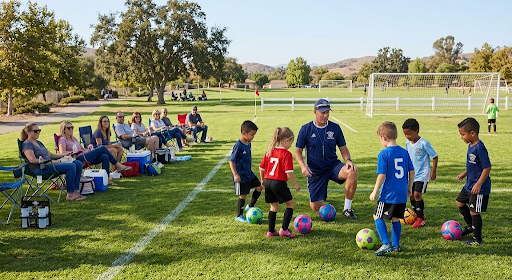
In the image above, we see a classic scene from American youth sports: a sprawling, pristine facility where a professional coach directs a small group of children while parents watch from the sidelines. The centralized authority of the coach guiding the children under the watchful, passive eyes of the adults.
While this looks organized and well-funded, it highlights exactly why the United States historically struggles to compete at the highest levels of global soccer. Most soccer experts agree that young players learn the fundamentals of the game at the grassroots in their neighborhoods. Once the young person’s potential is seen by scouts, the academies can be a wonderful environment to develop players into professionals, or if they are serious about making it on the international stage, they go to Europe. But until the sport is deeply rooted in the culture, the void will be filled with professionals – for better or worse!
The Global Model (Organic Play): In Argentina, Brazil, England, France, and across Africa, soccer is learned in the streets, alleys, and local parks. Children play unorganized, high-stakes pickup games for hours or join a club to learn from their peers and more experienced players. They learn spatial awareness, grit, and improvisational creativity because they have to survive the chaos.
The American Model (The Pay-to-Play Bubble): In the U.S., we have commercialized youth development. We hire professional coaches to run structured drills for an hour or two a week. The game becomes rigid, over-coached, and expensive.
By outsourcing the game to “experts,” we strip children of ownership, raw passion, and the thousands of unmonitored touches on the ball that breed true instinctual genius.
The Spiritual Parallel: The Dominant Centralized Church Model
This exact structural flaw is crippling the local church. Somewhere along the line, everyday Christians outsourced the Great Commission.
Just as soccer parents pull up a lawn chair to watch a hired coach develop their child’s athletic ability, churchgoers frequently sit in pews to watch a hired pastor do the work of ministry. We pay professionals to preach, evangelize, counsel, and plant churches, reducing the average believer to a passive consumer.
The Historical Reality: Church history and modern missiology prove that whenever the ministry of making disciples and planting churches is outsourced exclusively to professionals, movements plateau.
When a movement requires a seminary degree, a salary, and a corporate budget to function, it can lose the dynamics of a movement. It can become a bureaucracy.
The Path Forward: Returning the Game to the People
To spark a true Disciple-Making Movement (DMM)—or to build world-class soccer players—the strategy must shift from centralized professionalism to distributed empowerment.
Every believer is a disciple-maker; simple churches focus on mobilization to multiply.
Have you taken the Disciple-Making Assessment?
Breaking out of that deeply ingrained “spectator” mindset isn’t easy, but there are local communities successfully making the shift right now.
I recently picked up a book titled “7 Practices of Disciple Making Churches.” It is a fascinating read—one of the few I’ve found that digs into the traits of North American churches that are quietly adopting the powerful principles used by global disciple-making movements. Unlike the high-profile mega-churches that usually dominate our newsfeeds, these networks often fly under the radar, focusing more on depth than on the spotlight.
Are you ready to see where you stand? I’ve created an assessment to guide you and your team through the process to spark crucial conversations.
👉 [CLICK HERE to assess the Disciple-Making culture in your church!]
Let’s move together from just managing crowds to truly multiplying the Kingdom. I’d love to hear what you discover as you walk through this with your team!
The Coaching Secret: Why the Best Leaders Never Stop Growing
We have all met them—the leaders who seem to have it all together, yet their growth has hit a distinct plateau. Then, there are the others. The ones who are constantly expanding their capacity, handling fresh challenges with a surprising amount of grace, and lifting everyone around them.
When I reflect on the leaders I have coached or trained to be coaches, the vast majority were coachable. C.S. Lewis stated, ‘Humility is not thinking less of yourself, but thinking of yourself less.’ This is foundational to a coachable leader. Occasionally, I encountered leaders who thought a lot about themselves and less about others. It required a lot of heavy lifting and patience on my part to work with the latter.
What separates the two? It isn’t raw talent or a higher IQ. It comes down to one game-changing trait: coachability.
In his insightful book, Ten Marks of a Coachable Leader, Gary Rohrmayer unpacks what it looks like when a leader is truly ready to grow. If you are a coach, a mentor, or a leader wanting to invest in your team, recognizing these traits changes everything. Let’s walk through Rohrmayer’s ten marks together, complete with a quick gut-check for you as the coach and an inventory question to ask the leaders you serve.
1. Understanding Spiritual Authority
Coachable leaders recognize that they aren’t the ultimate authority; they operate under a bigger, divine map. They willingly yield their own ego and agenda because they respect the spiritual guardrails and leadership structures placed around them.
Self-Reflection for the Coach:Am I modeling a yielded life, or am I leaning too heavily on my own expertise and title?
Assessment Question for the Leader:Where are you currently wrestling with submission to authority, and how is that impacting your peace?
2. Action-Oriented
Insight without action is just a nice conversation. Coachable leaders don’t just nod along during a session; they leave the room looking for ways to immediately test, apply, and execute the strategies you discussed.
Self-Reflection for the Coach:Am I celebrating a leader’s insights, or am I pushing them toward concrete, measurable action steps?
Assessment Question for the Leader:Looking at our last conversation, what is the single most important action step you took?
3. Stretchable
True growth happens right at the edge of our comfort zones. These leaders don’t shrink back when a goal feels intimidating; instead, they allow their coaches to expand their thinking, their capacity, and their vision for what is possible.
Self-Reflection for the Coach:Am I playing it too safe with this leader, or am I offering healthy challenges that stretch their faith and skills?
Assessment Question for the Leader:What is one goal on your plate right now that feels just beyond your current strength, and how can we approach it?
4. Exhibiting Readiness and Adaptability
Change is the only constant in leadership, and coachable people don’t break when the winds shift. They maintain an agile mindset, staying mentally prepared to pivot their strategies when circumstances mutate.
Self-Reflection for the Coach:Am I helping this leader anticipate shifting tides, or am I just helping them manage their current routine?
Assessment Question for the Leader:When unexpected changes hit your organization recently, how did your team see you respond?
5. Taking Initiative with the Coach
The best coaching relationships are pulled, not pushed. A coachable leader doesn’t wait for their mentor to chase them down, send reminders, or provide artificial motivation; they own their growth and actively drive the relationship forward.
Self-Reflection for the Coach:Am I doing too much heavy lifting or chasing this leader down to get them to show up?
Assessment Question for the Leader:How can you take greater ownership of our time together to ensure we are tackling your highest priorities?
6. Making Key Adjustments
It is one thing to identify a blind spot; it’s quite another to actually change your behavior. Coachable leaders have the humility and willpower to alter their habits, schedules, and communication styles based on honest feedback.
Self-Reflection for the Coach:Am I giving specific, actionable feedback that allows the leader to make precise behavioral shifts?
Assessment Question for the Leader:What is one piece of recent feedback you’ve received that requires you to alter a daily habit?
7. Embracing Reality
You cannot fix what you refuse to see. Leaders who are ready to grow don’t sugarcoat bad numbers, minimize conflict, or make excuses for poor performance—they look reality square in the eye so they can deal with it honestly.
Self-Reflection for the Coach:Am I letting this leader spin a narrative, or am I gently helping them confront the hard, objective facts?
Assessment Question for the Leader:If we strip away all the excuses, what is the raw, unvarnished truth about the current state of your ministry?
8. Tenacious
Growth isn’t a straight line upward; it involves setbacks, criticism, and flat-out exhausting days. Tenacious leaders possess the grit to stay the course, honoring their commitments and pushing through obstacles even when the initial excitement fades.
Self-Reflection for the Coach:How am I fortifying this leader’s endurance and spiritual reserves rather than just giving them tactical advice?
Assessment Question for the Leader:Where are you feeling tempted to throw in the towel right now, and what is keeping you anchored?
9. Possessing a Constructive Spirit of Discontent
This isn’t a toxic, cynical complaint—it’s a holy restlessness. Coachable leaders have a deep gratitude for where they are, combined with a sharp, clear vision that whispers, “This could be better, and we can go further.”
Self-Reflection for the Coach:Am I helping the leader distinguish between healthy, visionary discontent and unhealthy, exhausting burnout?
Assessment Question for the Leader:What is the one area under your leadership that you are most proud of, yet know has the greatest room to grow?
10. Letting Go of the Past and Pushing Forward
Yesterday’s failures can paralyze us, but yesterday’s successes can trap us just as easily. A coachable leader processes the past, extracts the wisdom, and then consciously releases it so they can run unhindered into the future God has prepared for them.
Self-Reflection for the Coach:Am I allowing this leader to live in the rearview mirror, or am I consistently pointing their gaze to the horizon?
Assessment Question for the Leader:What old narrative, failure, or past success do you need to finally leave behind so you can fully step into what’s next?
Why This Book Belongs on Your Shelf
If your mission is to empower other leaders, Ten Marks of a Coachable Leader is a critical tool for your toolkit. Here is how it maximizes your impact:
Smarter Selection: Use these ten marks as a strategic grid to vet the leaders and emerging leaders around you. It will help you quickly identify the hungriest, highest-potential leaders so you can invest your limited time and energy where it will yield the greatest return.
Personal Clarification: Leadership development is a mirror. This book serves as a personal gut-check, reminding you to keep your own spirit humble, stay coachable, and fully capitalize on the growth opportunities right in front of you.
Immediate Accessibility: Don’t let the slim size fool you. This is a clear, fast-paced read packed with highly practical insights that you can immediately apply to your own life and share with the leaders you are mentoring.
The Bottom Line: Coaching isn’t about fixing broken leaders; it’s about unlocking the latent potential in healthy, hungry ones. When you spot these ten marks, you aren’t just looking at a leader—you’re looking at a catalyst for the future.
The beauty of a truly effective coaching framework lies not in its complexity, but in its simplicity. When a process is straightforward, it becomes reproducible—allowing leaders to pass it on and empower others seamlessly. I am always on the lookout for ways to communicate what coaching is and how it works.
The framework taught by Gary Rohrmayer at www.axelerate.org nails this balance perfectly. It strips away the academic fluff and provides a clear, three-stage roadmap powered by nine core skills that can transform any leadership conversation. It is causing me to rethink how I communicate the coaching process we use in a more reproducible manner.
Here is a breakdown of how this simple, reproducible process works and the skills that bring it to life.
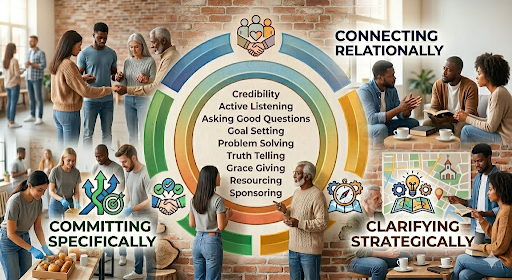
The Three-Stage Coaching Process
This process flows logically from building trust to taking decisive action. Because it is easy to memorize and execute, it can be scaled across any ministry context.
1. Connecting Relationally
Every great coaching relationship begins with trust, not an agenda. Before diving into goals or strategies, a coach establishes rapport and alignment. This stage is about ensuring the person feels seen, heard, and valued. Without a strong relational foundation, any strategic advice given later will carry little weight.
2. Clarifying Strategically
Once a relational bridge is built, the focus shifts to gaining clarity. This is where you help the leader look at the big picture, unpack their current reality, and identify the actual roadblocks or opportunities ahead of them. It is about narrowing down a chaotic list of ideas into a focused strategic direction.
3. Committing Specifically
Clarity without commitment is just a nice conversation. The final phase of the process anchors the discussion into reality. The coach helps the leader define clear, measurable next steps, establishing ownership and timelines. By leaving the conversation with a specific commitment, the leader knows exactly what success looks like before the next meeting.
The 9 Core Skills of an Effective Coach
While the three-stage process provides the tracks, these nine essential skills serve as the engine. They aren’t confined to a single stage; rather, they are woven throughout the entire coaching conversation.
Skill
Description
Credibility
Your character, competence, and consistency. It’s what earns you the right to be heard in the leader’s life.
Active Listening
Hearing what is said and what is left unsaid. It requires giving 100% of your attention and reflecting back what you hear.
Asking Good Questions
Shifting from telling to asking. Open-ended questions spark self-discovery and unlock insights that a directive statement never could.
Goal Setting
Helping the leader articulate clear, realistic, and inspiring milestones that stretch them without breaking them.
Problem Solving
Guiding the leader to diagnose obstacles objectively and brainstorm creative paths around them.
Truth Telling
Speaking the hard truth with love. A great coach names reality and offers honest feedback when a leader has a blind spot.
Grace Giving
Creating a safe space for failure. When a leader falls short of a goal, grace ensures they view it as a learning opportunity rather than a dead end.
Resourcing
Knowing when to introduce a tool, a book, a contact, or a concept that accelerates the leader’s growth.
Sponsoring
Championing the leader. Believing in them, advocating for them, and reminding them of their potential when their own confidence wavers.
The Takeaway: The power of Rohrmayer’s framework is that it doesn’t require a master’s degree to implement. By mastering the rhythm of Connecting, Clarifying, and Committing—while leaning into these nine foundational skills—any leader can create a culture of continuous development. It is coaching stripped down to its most potent, reproducible essence.
When it comes to coaching disciples and disciple-makers, accountability is a delicate dance. I’m often reminded of this with the small group of men I lead. If I come in too hot, it pushes people away. If I’m too soft, the impact gets lost.
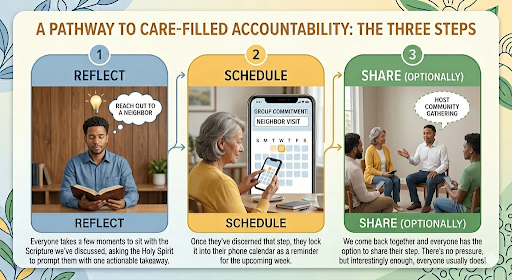
Over the years, I’ve found a “gentle but firm” sweet spot that works beautifully, and it boils down to a simple routine we practice during the last 15 minutes of our time together:
1. Reflect: Everyone takes a few moments to sit with the Scripture we’ve discussed and ask the Holy Spirit to prompt them with one actionable takeaway.
2. Schedule: Once they’ve discerned that step, they lock it into their phone calendar as a reminder for the upcoming week.
3. Share (Optionally): We come back together, and everyone has the option to share their step. There’s no pressure, but interestingly enough, everyone usually does!
The following week, we open our session with a quick check-in to hear what everyone learned. What I love about this approach is that it builds organic accountability on everyone’s own terms—including mine!
Learning from the Best
As a coach, I always keep an eye out for world-class secular experts whose insights can be curated to serve leaders in the church, church planting networks, and international missions.
That’s why Michael Bungay Stanier has caught my attention recently.
You might know him as the author of The Coaching Habit (the best-selling book on coaching this century) or recognize him as a Rhodes Scholar named by the ICF and Thinkers50 as a premier voice shaping modern coaching. He’s a brilliant Australian living in Canada, and he has some profound things to say about accountability.
I think his perspective is well worth tuning into at the FREEupcoming Coaching.com Summit on June 8th at 7:00 AM PST / 10:00 AM EST.
While my immediate thought is how this can empower front-line disciple-makers, his insights apply just as powerfully to pastors, church planters, and executive leaders serving in the organizational C-suite.
His session, “Courageous Commitment: The Accountability Shift for Coaches,” promises to deliver three great takeaways:
1. Three insights that explain exactly why it’s so hard to hold ourselves to the tasks we truly want to achieve.
2. Three paradoxes about accountability that will twist your thinking up in the most delightful way.
3. A surprise finale that’s under wraps— you’ll have to tune in to see it unfold!
If you’re looking to sharpen how you maintain accountability for yourself first and foremost, walk alongside others as they make disciples, and elevate leaders you empower through coaching in their ministries, I’d love for you to join me for this webinar.
Here is how to register – CLICK HERE. Sign up for the FREE access. You will have access to a bunch of other sessions that might be of interest as well, but I recommend “Courageous Commitment: The Accountability Shift for Coaches,” led by Michael Bungay Stanier.
We use cookies to optimize our website and our service.
Functional
Always active
The technical storage or access is strictly necessary for the legitimate purpose of enabling the use of a specific service explicitly requested by the subscriber or user, or for the sole purpose of carrying out the transmission of a communication over an electronic communications network.
Preferences
The technical storage or access is necessary for the legitimate purpose of storing preferences that are not requested by the subscriber or user.
Statistics
The technical storage or access that is used exclusively for statistical purposes.The technical storage or access that is used exclusively for anonymous statistical purposes. Without a subpoena, voluntary compliance on the part of your Internet Service Provider, or additional records from a third party, information stored or retrieved for this purpose alone cannot usually be used to identify you.
Marketing
The technical storage or access is required to create user profiles to send advertising, or to track the user on a website or across several websites for similar marketing purposes.