
The High Cost of the “Expert” Mindset: Why Pay-to-Play Soccer and Professionalized Ministry Can Hinder Movements
During my early morning walk, I noticed a scene that illustrated one of the great challenges in disciple-making movements in the West. There is a striking parallel between the way the US develops its soccer players and the way the dominant centralized church model in the US attempts to develop disciples. In both arenas, we have fallen into the trap of professionalization. We operate under the assumption that if we want real results, we must outsource the work to hired experts.
The results, however, speak for themselves: stagnation, plateaued growth, and a distinct lack of the creative, organic movement seen across the rest of the globe.
The Soccer Problem: Street Ball vs. The Structured Academy
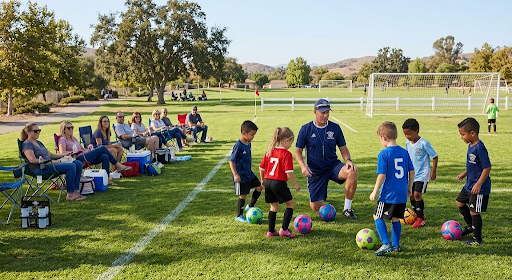
In the image above, we see a classic scene from American youth sports: a sprawling, pristine facility where a professional coach directs a small group of children while parents watch from the sidelines. The centralized authority of the coach guiding the children under the watchful, passive eyes of the adults.
While this looks organized and well-funded, it highlights exactly why the United States historically struggles to compete at the highest levels of global soccer. Most soccer experts agree that young players learn the fundamentals of the game at the grassroots in their neighborhoods. Once the young person’s potential is seen by scouts, the academies can be a wonderful environment to develop players into professionals, or if they are serious about making it on the international stage, they go to Europe. But until the sport is deeply rooted in the culture, the void will be filled with professionals – for better or worse!
- The Global Model (Organic Play): In Argentina, Brazil, England, France, and across Africa, soccer is learned in the streets, alleys, and local parks. Children play unorganized, high-stakes pickup games for hours or join a club to learn from their peers and more experienced players. They learn spatial awareness, grit, and improvisational creativity because they have to survive the chaos.
- The American Model (The Pay-to-Play Bubble): In the U.S., we have commercialized youth development. We hire professional coaches to run structured drills for an hour or two a week. The game becomes rigid, over-coached, and expensive.
By outsourcing the game to “experts,” we strip children of ownership, raw passion, and the thousands of unmonitored touches on the ball that breed true instinctual genius.
The Spiritual Parallel: The Dominant Centralized Church Model
This exact structural flaw is crippling the local church. Somewhere along the line, everyday Christians outsourced the Great Commission.
Just as soccer parents pull up a lawn chair to watch a hired coach develop their child’s athletic ability, churchgoers frequently sit in pews to watch a hired pastor do the work of ministry. We pay professionals to preach, evangelize, counsel, and plant churches, reducing the average believer to a passive consumer.
The Historical Reality: Church history and modern missiology prove that whenever the ministry of making disciples and planting churches is outsourced exclusively to professionals, movements plateau.
When a movement requires a seminary degree, a salary, and a corporate budget to function, it can lose the dynamics of a movement. It can become a bureaucracy.
The Path Forward: Returning the Game to the People
To spark a true Disciple-Making Movement (DMM)—or to build world-class soccer players—the strategy must shift from centralized professionalism to distributed empowerment.
| Domain | The Centralized Model | The Distributed Model |
| Ministry | Clergy-driven, spectator-heavy, program-dependent, plateaued growth. | Every believer is a disciple-maker; simple churches focus on mobilization to multiply. |
Have you taken the Disciple-Making Assessment?
Breaking out of that deeply ingrained “spectator” mindset isn’t easy, but there are local communities successfully making the shift right now.
I recently picked up a book titled “7 Practices of Disciple Making Churches.” It is a fascinating read—one of the few I’ve found that digs into the traits of North American churches that are quietly adopting the powerful principles used by global disciple-making movements. Unlike the high-profile mega-churches that usually dominate our newsfeeds, these networks often fly under the radar, focusing more on depth than on the spotlight.
Are you ready to see where you stand? I’ve created an assessment to guide you and your team through the process to spark crucial conversations.
👉 [CLICK HERE to assess the Disciple-Making culture in your church!]
Let’s move together from just managing crowds to truly multiplying the Kingdom. I’d love to hear what you discover as you walk through this with your team!