
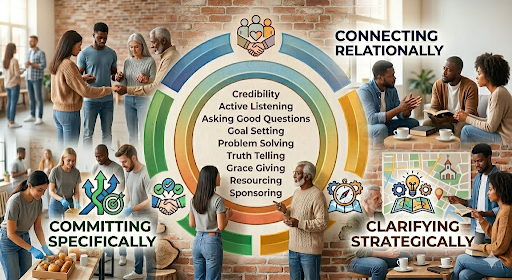
The beauty of a truly effective coaching framework lies not in its complexity, but in its simplicity. When a process is straightforward, it becomes reproducible—allowing leaders to pass it on and empower others seamlessly. I am always on the lookout for ways to communicate what coaching is and how it works.
The framework taught by Gary Rohrmayer at www.axelerate.org nails this balance perfectly. It strips away the academic fluff and provides a clear, three-stage roadmap powered by nine core skills that can transform any leadership conversation. It is causing me to rethink how I communicate the coaching process we use in a more reproducible manner.
Here is a breakdown of how this simple, reproducible process works and the skills that bring it to life.
The Three-Stage Coaching Process
This process flows logically from building trust to taking decisive action. Because it is easy to memorize and execute, it can be scaled across any ministry context.
1. Connecting Relationally
Every great coaching relationship begins with trust, not an agenda. Before diving into goals or strategies, a coach establishes rapport and alignment. This stage is about ensuring the person feels seen, heard, and valued. Without a strong relational foundation, any strategic advice given later will carry little weight.
2. Clarifying Strategically
Once a relational bridge is built, the focus shifts to gaining clarity. This is where you help the leader look at the big picture, unpack their current reality, and identify the actual roadblocks or opportunities ahead of them. It is about narrowing down a chaotic list of ideas into a focused strategic direction.
3. Committing Specifically
Clarity without commitment is just a nice conversation. The final phase of the process anchors the discussion into reality. The coach helps the leader define clear, measurable next steps, establishing ownership and timelines. By leaving the conversation with a specific commitment, the leader knows exactly what success looks like before the next meeting.
The 9 Core Skills of an Effective Coach
While the three-stage process provides the tracks, these nine essential skills serve as the engine. They aren’t confined to a single stage; rather, they are woven throughout the entire coaching conversation.
| Skill | Description |
| Credibility | Your character, competence, and consistency. It’s what earns you the right to be heard in the leader’s life. |
| Active Listening | Hearing what is said and what is left unsaid. It requires giving 100% of your attention and reflecting back what you hear. |
| Asking Good Questions | Shifting from telling to asking. Open-ended questions spark self-discovery and unlock insights that a directive statement never could. |
| Goal Setting | Helping the leader articulate clear, realistic, and inspiring milestones that stretch them without breaking them. |
| Problem Solving | Guiding the leader to diagnose obstacles objectively and brainstorm creative paths around them. |
| Truth Telling | Speaking the hard truth with love. A great coach names reality and offers honest feedback when a leader has a blind spot. |
| Grace Giving | Creating a safe space for failure. When a leader falls short of a goal, grace ensures they view it as a learning opportunity rather than a dead end. |
| Resourcing | Knowing when to introduce a tool, a book, a contact, or a concept that accelerates the leader’s growth. |
| Sponsoring | Championing the leader. Believing in them, advocating for them, and reminding them of their potential when their own confidence wavers. |
The Takeaway: The power of Rohrmayer’s framework is that it doesn’t require a master’s degree to implement. By mastering the rhythm of Connecting, Clarifying, and Committing—while leaning into these nine foundational skills—any leader can create a culture of continuous development. It is coaching stripped down to its most potent, reproducible essence.
Used with permission from Gary Rohrmayer.